

 English
 中文简体
 русский
 Français
 Español
 Deutsch

Types of Warp Knitting Machines: Tricot, Raschel, Biaxial and Multiaxial
2026-10-21
Content
- 1 The four layers of classification, in the order that matters
- 2 Tricot machines: fine gauge, compound needles, high throughput
- 3 Raschel machines: coarse yarns, wide widths, technical fabrics
- 4 Simplex and Milanese: the two smaller families
- 5 Needle type and draw-off direction: two labels buyers often confuse
- 6 How the main families compare on paper
- 7 Weft insertion: where warp knitting becomes biaxial, multiaxial and stitch-bonding
- 8 Matching the family to the fibre: chemical, glass and carbon
- 9 What to write into the specification before comparing quotations
- 10 Choose the fabric, then the family
Two buyers open the same catalogue and both ask for a warp knitting machine. One needs a 4.5 m wide glass-fibre geogrid with 0° and 90° yarns stitched together for a soil-reinforcement contract; the other needs fine-gauge fabric for a sportswear lining running at close to 2,000 courses per minute. Their shortlists have almost nothing in common, because "warp knitting machine" is a family name, not a specification.
The short version: warp knitting machines are separated by needle type, by machine geometry and fabric draw-off, by the number of needle bars, and by whether weft yarns are inserted. That last split turns a plain warp knitter into a biaxial, multiaxial or stitch-bonding machine, and it usually decides which supplier you should even be talking to.
The four layers of classification, in the order that matters
Sorting by these four attributes in sequence is practical because each layer removes whole categories of machine, and whole categories of quotation, before you get anywhere near gauge and working width.
- Needle type: bearded (crochet), latch (tongue) or compound. This decides running speed, how gently the yarn is handled, and how much of your maintenance budget goes to needles.
- Geometry and draw-off: tricot, raschel, simplex or Milanese. Tricot takes the fabric away at a shallow angle; raschel takes it away at close to 90° to the needle bar.
- Needle bars: one bar, or two bars facing each other. Double-bar machines open up spacer fabrics, tubular structures and two-faced constructions.
- Weft insertion: none, 0°/90° (biaxial), ±45° added on top of that (multiaxial), or a stitched fibre web rather than a yarn loop (stitch-bonding).
If the loop mechanics are not yet clear, it helps to read how a warp knitting machine forms a stitch before comparing machine families. The rest of this article assumes you know that a guide bar laps yarn around needles and that one warp yarn feeds each needle.
Tricot machines: fine gauge, compound needles, high throughput
Tricot is the workhorse of fine-gauge warp knitting. Most modern tricot machines run compound needles, one or two needle bars and two to four guide bars, with a draw-off that pulls the fabric away at a shallow angle so the fabric path stays short and lightly tensioned. That geometry is exactly what lets a fine-gauge tricot run at speeds that would destroy a raschel.
Typical gauge sits between E28 and E40, meaning 28 to 40 needles per inch, with yarn counts mostly from 20 to 150 denier for polyester and nylon. Working widths of 130 to 170 inches, roughly 3.3 to 4.3 m, are common. The fabric comes off flat, dense and dimensionally stable, with limited stretch and a clean surface for later coating or lamination.
What it makes: lingerie and swimwear, sportswear, lining fabrics, automotive interior lining, mattress ticking and the smooth base cloths that end up coated, laminated or printed.
Where buyers get caught: compound needles cost more than latch needles and they punish poor yarn. A single bent needle leaves a visible vertical line down the full length of the beam, so the savings on a cheap yarn supply reappear quickly as needle consumption and seconds.
Raschel machines: coarse yarns, wide widths, technical fabrics
Raschel machines are recognised by the near-perpendicular draw-off, the longer fabric path and the number of guide bars, which runs from two up to six or more, with jacquard bars on lace machines. Latch needles dominate, though compound needles appear on faster models. The defining capability is tolerance for coarse, bulky and inexpensive yarns.
Gauge is coarser, roughly E6 to E24, and the yarn range stretches from heavy polyester to polypropylene tape and glass roving measured in tex rather than denier. Widths above 200 inches (5 m) are routine for nets and geotextiles, and machines of 260 inches exist for the widest shade-net and agro-net fabrics.
What it makes: lace and curtain net, powernet, spacer fabrics on double-bar machines, geogrids, shade net, bale-wrap net, and a long list of technical fabrics where the open structure is the product rather than a compromise.
Where buyers get caught: at coarse gauge, stitch cams and needles wear quickly when abrasive yarns such as glass or basalt are running. Ask for the consumable list, the recommended spare set and the expected needle life in hours before you sign.
Simplex and Milanese: the two smaller families
Simplex uses two needle bars facing each other with two guide bars, so the fabric carries loops on both faces. Milanese feeds two sets of warp yarns at an angle onto a single needle bar, producing a fine, dense and highly stable cloth.
Neither family dominates the market, and that has commercial consequences: fewer builders, longer delivery times and a thinner second-hand market. They are chosen for specific fabric properties rather than productivity, and a project that begins with "we need a simplex" usually deserves a second look at whether a double-bar raschel can reach the same fabric with a more forgiving supply chain.
Needle type and draw-off direction: two labels buyers often confuse
Classifying by needle gives three groups: bearded (crochet) needle machines, latch (tongue) needle machines and compound needle machines. Bearded needles need a presser and are now largely confined to older and coarse machines. Latch needles are cheap, robust and happy with thick yarns, but the latch itself can abrade fine filament. Compound needles are two-part, travel straight and treat yarn most gently, which is why they dominate modern tricot and multiaxial builds.
The draw-off classification separates machines that pull the fabric away parallel to the needle bar from those that pull it away at about 90°. This is the practical definition of tricot against raschel, and it explains the speed gap better than needle type does: the tricot path is short and the tension low, while the raschel path is longer and the fabric is held out wider.
How the main families compare on paper
Use the table as a first filter for a shortlist, never as a specification.
| Family | Common needle | Gauge band | Yarn tolerance | Typical products | Draw-off |
|---|---|---|---|---|---|
| Tricot | Compound, some latch | Fine, about E28 to E40 | Fine filament, roughly 20 to 150 denier | Lingerie, lining, sportswear, sheeting, coating base | Shallow angle, high speed |
| Raschel | Latch, some compound | Coarse, about E6 to E24 | Spun, tape, textured, glass roving | Lace, net, spacer fabric, geogrid, shade net | Near 90°, wide widths |
| Simplex | Compound, two needle bars | Fine | Fine filament | Two-faced fabrics for niche technical uses | Moderate |
| Milanese | Bearded or compound | Fine | Fine filament | Dense, stable cloth in small volumes | Moderate, low market share |
| Biaxial and multiaxial | Compound with weft insertion | Not gauge-led | Roving, heavy tow, glass and carbon | Geogrid, tarpaulin, composite reinforcement | Layered 0°/90° or with ±45° |
Weft insertion: where warp knitting becomes biaxial, multiaxial and stitch-bonding
Biaxial machines
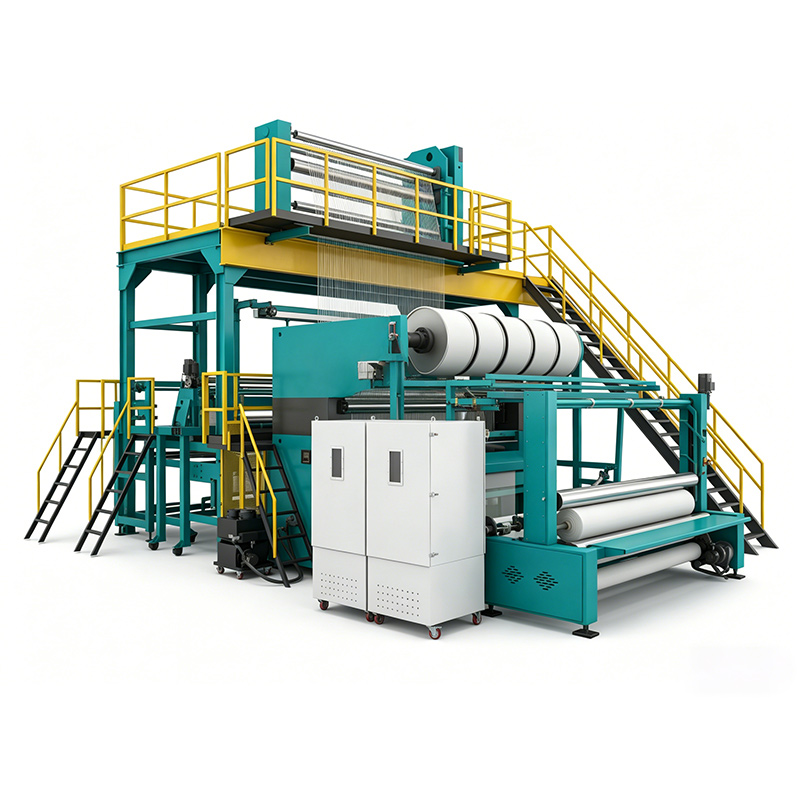
A weft carriage lays yarn across the full width at 90° while the warp sheet runs at 0°, and a fine binding yarn, often 50 to 150 denier polyester, knits the two layers together. Neither layer is crimped, so tensile strength is high and elongation at break is low. That is why biaxial fabric dominates geogrids, tarpaulins, banners and truck covers. Stitch pitch and binding density are the two settings that define the finished product, and both must be agreed in writing rather than assumed from a sample.
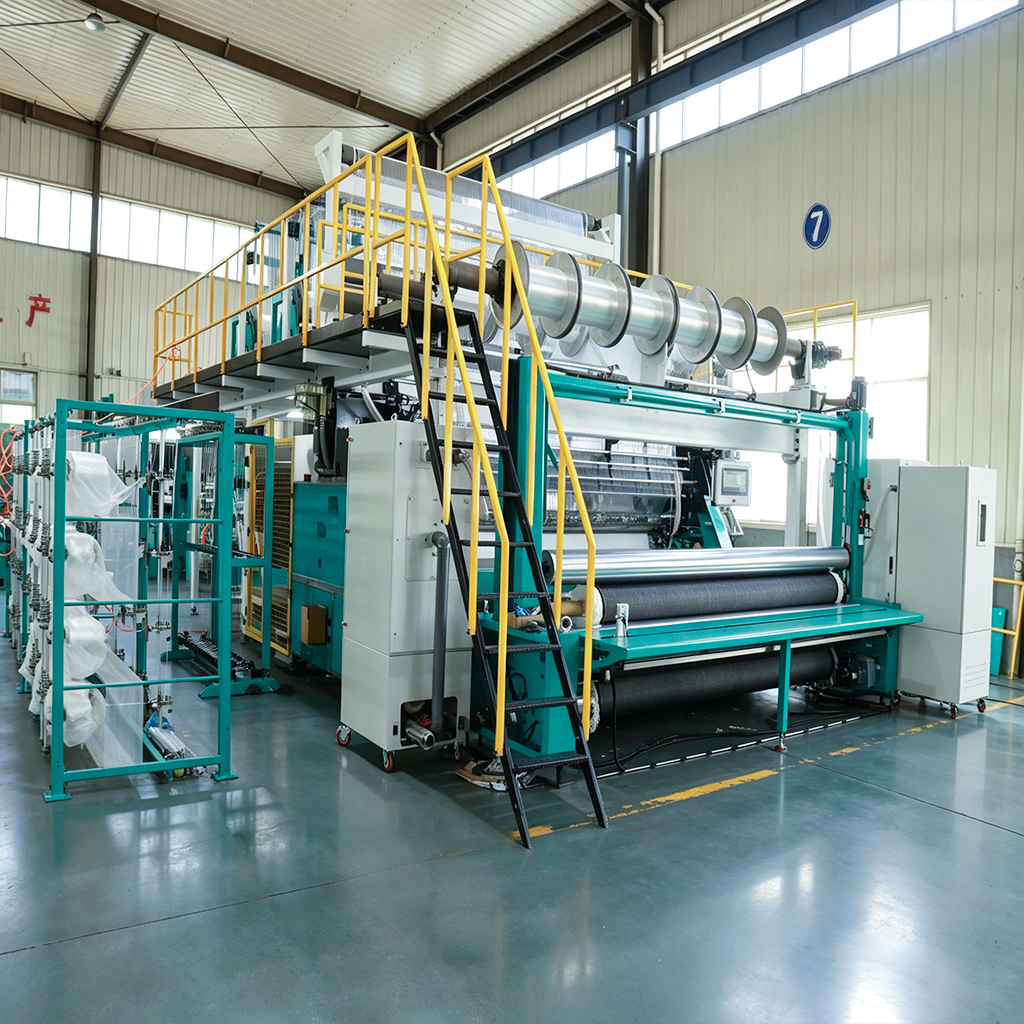
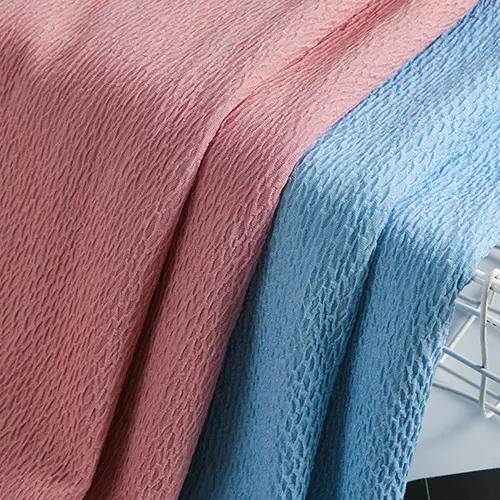
 YXKS2-M Biaxial Warp Knitting MachineHigh-speed Tricot-type biaxial warp knitting machine for chemical fiber filaments and polyester, configurable for garment interlining and crepe fabric production with adjustable weft insertion.View Product →
Multiaxial machines
Rotating carriages add ±45° layers, and some builds offer steeper angles, so a single pass can assemble a 0°/90°/±45° stack. This is the construction behind composite reinforcement, where fibre straightness converts directly into stiffness. Layer order, angle tolerance and stitch tension are the three variables that separate a good laminate from a rejected one.
Stitch-bonding, chopped fibre and laid scrim
Stitch-bonding machines do not knit from previously formed loops; they stitch a fibre web with warp yarns, which makes them the bridge between nonwoven and warp knitting. Chopped fibre versions cut glass strand and stitch it into a mat, laid scrim machines lay rovings in a grid and bind the intersections, and powder scattering units add binder before or after stitching. If your product is a mat, a scrim or a wipe substrate, you are in this group and should not be shopping for tricot at all.
Matching the family to the fibre: chemical, glass and carbon
Chemical fibre work gives the widest choice, because polyester and nylon tolerate most needle types. Fine tricot covers apparel and lining, coarse raschel covers nets and lace, stitch-bonding covers wipes and coating substrates, and terry-style machines cover towel and plush fabric. The decision here is usually commercial, driven by fabric weight and target speed.
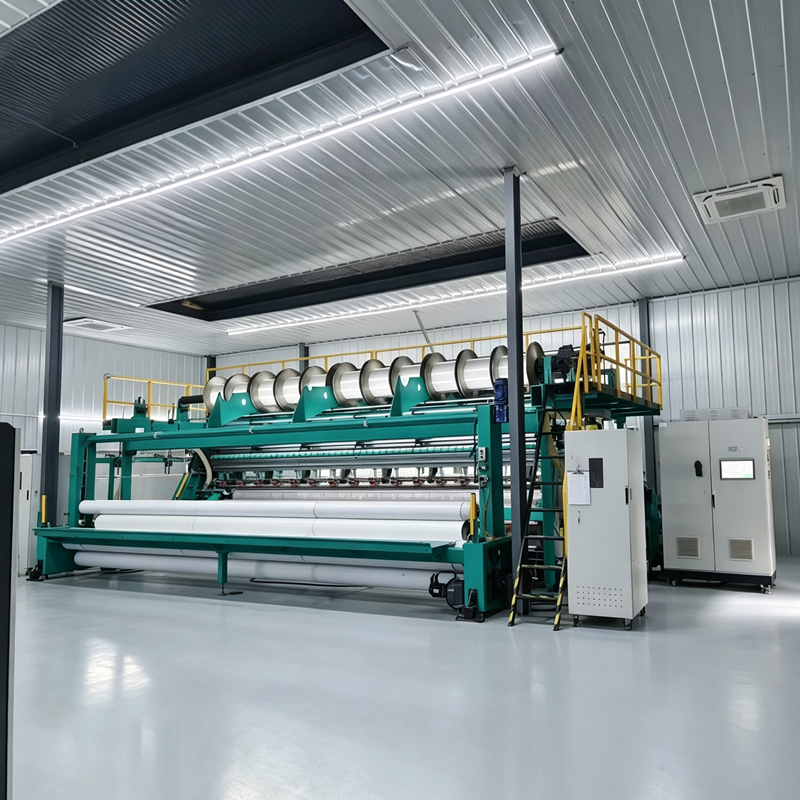
Glass fibre punishes any machine designed around polyester. Roving is abrasive, creels hold hundreds of packages, static builds up and broken filaments become airborne dust. A glass-capable machine needs hardened yarn contact points, individually tensioned creel positions, dust extraction, and enough structural stiffness to hold width across a 5 m beam. The fibreglass textile machine range is built around those constraints rather than retrofitted to them.
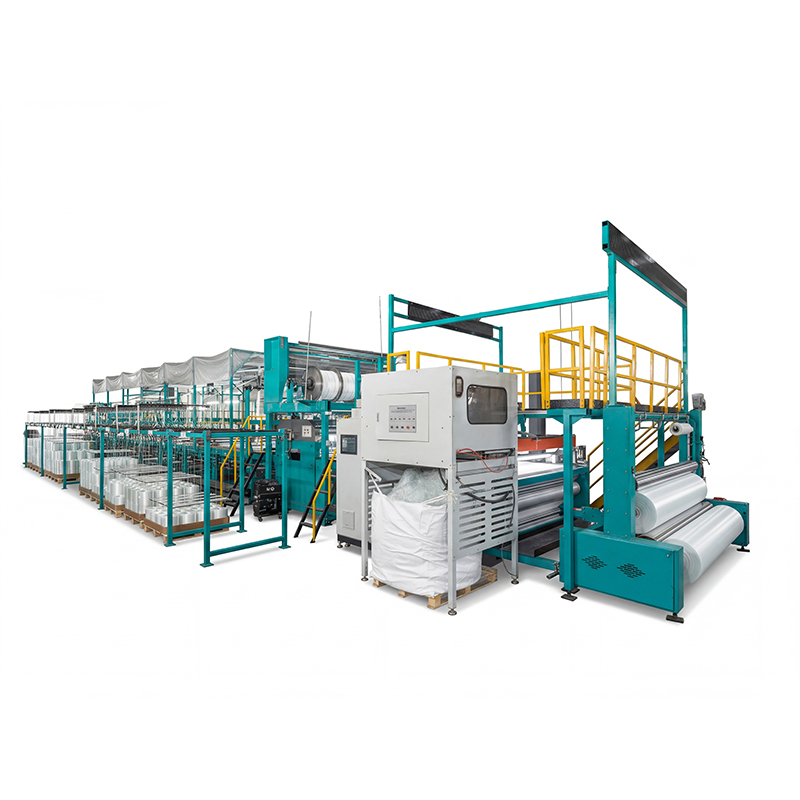 YRS3-3M Multi-Axial Warp Knitting MachineConfigurable multi-axial warp knitting platform for glass and basalt reinforcement fabrics, using three servo-controlled weft systems for aerospace, wind and automotive applications.View Product →
Carbon fibre is a different problem again: 12K to 50K tow must be spread into a flat tape, held at consistent tension across every position, and routed through bends gentle enough that filaments are not fractured. Tension variation of a few percent between positions shows up later as an unbalanced laminate that no amount of resin can correct.
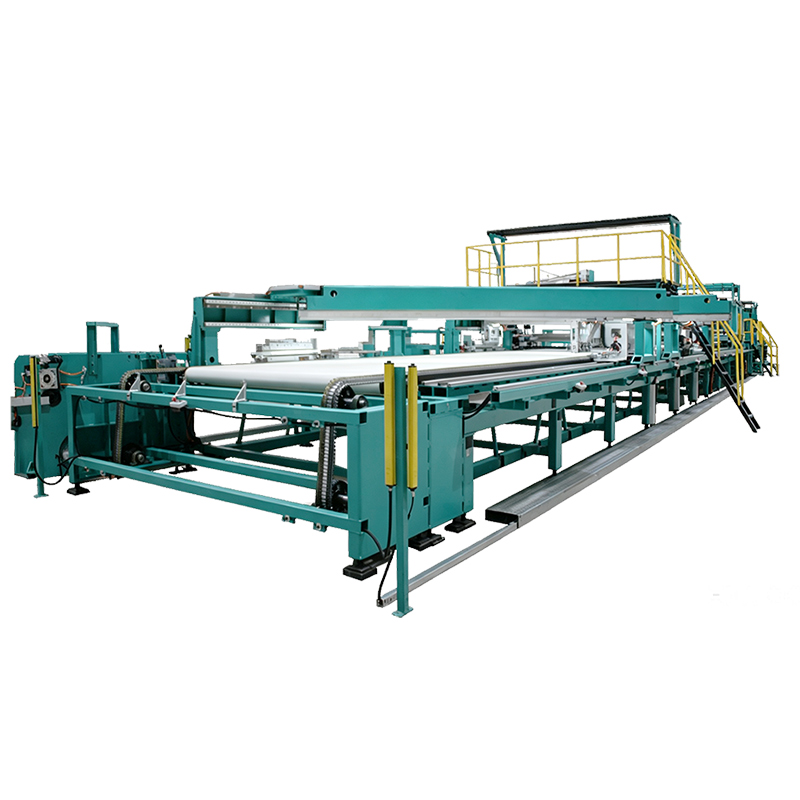 YRS3-3M-C Carbon Fiber Multi-Axial Warp Knitting MachineCarbon fiber multi-axial warp knitting machine for multi-layer, multi-directional reinforcement fabrics, with carbon-specific creel and yarn path adaptation for yacht, marine and automotive structural parts.View Product →
One practical test: ask the builder which fibre the frame, creel and yarn path were originally designed for. Machines adapted from a polyester platform usually reveal themselves in creel capacity, guide geometry and the spare-parts list.
What to write into the specification before comparing quotations
Most disappointing purchases trace back to a vague enquiry, not a bad machine. Put these items in the request:
- Fabric construction, areal weight in g/m², and the fibre type with denier or tex.
- Gauge in needles per inch, number of guide bars, needle type and expected needle life.
- Working width and usable width, plus warp beam flange diameter and beam weight limits.
- Weft insertion details: angle set, stitch pitch, binding yarn count and carriage speed.
- Creel capacity and package size, which is the single most common hidden cost on glass and carbon projects.
- Target speed, efficiency and connected power, expressed per hour rather than per shift.
- Draw-off and batching type, whether surface or centre winding, and roll diameter.
- Control platform, recipe storage, remote diagnostics and spare-parts lead times.
- Acceptance criteria: width tolerance, areal weight tolerance, tensile and elongation targets.
Then insist on a witness run with your own yarn at the builder's plant, and measure the fabric yourself. A machine that meets a datasheet with the builder's yarn and misses it with yours has not been accepted, whatever the paperwork says.
Choose the fabric, then the family
The classification is only useful once it is tied to a product. Start with the fabric weight, the fibre and the mechanical property that the customer is paying for, and the family follows: fine tricot for smooth apparel cloth, raschel for open and coarse structures, biaxial or multiaxial for straight-fibre reinforcement, stitch-bonding for web-based substrates. Get that order right and the gauge, width and creel questions answer themselves; get it wrong and no amount of specification detail will rescue the project.
News
-
A fabric engineer compares two swatches on a cutting table. One is a lightweight mesh that holds its shape, resists runs, and stretches very little. The other is a soft jersey that curls at the edges...
READ MORE -
Warp knitting is a combination of weaving methods in which the yarns meander along the length of the fabric; that is, they follow adjacent columns or wales, rather than a single row or course. For com...
READ MORE -
What Is a Tricot Warp Knitting Machine A tricot warp knitting machine is a textile production machine that forms fabric by looping many parallel yarns fed from a warp beam, with each needle working i...
READ MORE -
Two quotations land on the same desk. Both offer a multiaxial warp knitting line, both list the same working width, both promise high output. One buyer signs and discovers six months later that the f...
READ MORE
-
Contact Info.
+86-198 5534 1617
+86-134 0158 3002yuanyang@yywarpknitting.com 699#, Shengzhi West Rd, Lvcheng Town, Danyang City, Zhenjiang City, Jiangsu Province, China

-
QR Code
-
Quick Links
Home About Products Manufacturing Customization News Contact -
Product List
Machine for Chemical Fiber Textile Machine for Fiberglass Textile Machine for Carbon Fiber Textile -
About Us
Company Profile Factory Gallery Value-added Service
Copyright © 2026 Changzhou Yuanyang Electromechanical Technology Co., Ltd. All Rights Reserved.
Custom Warp Knitting Machine Manufacturers
