

 English
 中文简体
中文简体 русский
 Français
 Español
 Deutsch
What Is a Warp Knitting Machine and How Does It Work?
2026-09-16
Content
- 1 Warp Knitting Machines: Machine Architecture, Yarn Control and Industrial Fabric Output
- 1.1 What Is a Warp Knitting Machine?
- 1.2 How Does a Warp Knitting Machine Work? The Knitting Cycle Step by Step
- 1.3 Machine Classes and Technical Parameters
- 1.4 Beam Preparation: The Step That Decides Fabric Quality
- 1.5 Uses of Warp Knitting Machines Across Industrial Sectors
- 1.6 Differences Between Warp Knitting and Weft Knitting
- 1.7 Which Is Stronger, Warp or Weft?
- 1.8 What Is the Difference Between a Warp and a Weft?
- 1.9 Are Spandex Produced on Warp Knitting Machine?
- 1.10 Choosing Gauge, Bars and Structure for a Target Fabric
- 1.11 Core Warp Knitted Structures and Their Behaviour
- 1.12 Production Speed, Efficiency and Output Calculation
- 1.13 Defect Analysis and Corrective Action on the Knitting Floor
- 1.14 Preventive Maintenance Schedule for Continuous Operation
- 1.15 Yarn Selection Guide for Warp Knitted Fabric
- 1.16 How Does a Warp Knitting Machine Work Compared with Other Fabric-Forming Systems?
- 1.17 Frequently Raised Technical Questions
- 1.17.1 What is warp knitting machine used for in heavy industry?
- 1.17.2 How does a warp knitting machine handle pattern changes?
- 1.17.3 Which is stronger, warp or weft, in a finished knitted fabric?
- 1.17.4 Are spandex produced on warp knitting machine at commercial scale?
- 1.17.5 What is the difference between a warp and a weft in a knitted structure?
- 1.18 Commissioning a New Warp Knitting Line: Practical Sequence
- 1.19 Energy, Floor Space and Supporting Infrastructure
- 1.20 Fabric Weight, Cover Factor and Their Effect on Machine Settings
- 1.21 Elastic Recovery Testing for Spandex-Containing Warp Knitted Fabric
- 1.22 Working with Warp Knitted Fabric in Downstream Processing
Warp Knitting Machines: Machine Architecture, Yarn Control and Industrial Fabric Output
Inside a warp knitting machine, every single yarn has its own itinerary. A thousand or more ends leave their beams together, swing through the guide bars, pass between the needles and lock into a fabric structure that is built one course at a time — with all needles working in parallel. That single engineering decision, feeding yarn along the length of the fabric instead of across it, is what separates warp knitting from every other loop-forming process and what gives the technology its speed, its dimensional stability and its very specific set of industrial applications.
For mills that produce technical textiles, elastic lace, footwear uppers, medical mesh or geocomposites, understanding the internal logic of a warp knitting machine is not academic. Machine gauge, guide bar configuration, beam preparation and yarn tension control all translate directly into fabric weight, elongation, porosity and tear resistance. This section walks through the machine from the beam to the batcher, explains where spandex fits into the picture, and compares warp and weft structures on the properties that matter most in end use.
What Is a Warp Knitting Machine?
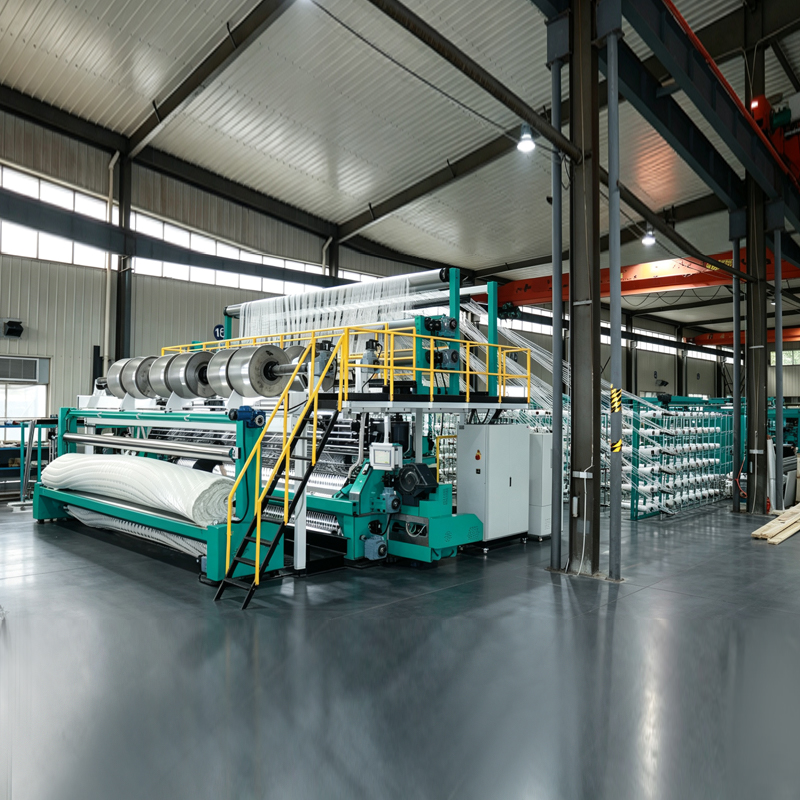
A warp knitting machine is a loop-forming machine in which the yarn supply runs parallel to the direction in which the fabric is produced. Each yarn end is delivered from a warping beam, threaded through a guide in a guide bar, and formed into a loop by a needle that operates in a fixed position within the needle bed. Because the needles are arranged across the full working width and all of them knit on every machine revolution, the machine produces one complete course of loops per cycle.
This is the opposite of the logic used in weft knitting, where a single yarn is carried back and forth across the needle bed, supplying one needle after another. In a warp knitting machine, the number of yarns entering the knitting zone during one cycle equals the number of active needles. On a 130-inch machine running at E32 gauge, that is more than four thousand yarn ends forming loops simultaneously.
Beam and Let-Off System
Warp beams are mounted on shafts and rotated at a controlled rate. Electronic let-off units adjust rotational speed continuously to compensate for the shrinking beam diameter, keeping yarn tension stable from the first metre to the last.
Loop-Forming Zone
Needles, guide bars, sinkers or knock-over bits, and the needle bed work together. Compound needles dominate modern high-speed machines because the closed hook profile reduces yarn damage at high cycle rates.
Take-Down Unit
Rollers pull the formed fabric away from the needle line at a defined rate. Take-down speed relative to let-off speed determines courses per centimetre and therefore fabric weight.
Batching and Winding
The finished fabric is wound onto a batcher under controlled tension. Consistent winding prevents edge curling, crease marks and tension memory that would otherwise appear during dyeing or lamination.
How Does a Warp Knitting Machine Work? The Knitting Cycle Step by Step
The knitting cycle on a warp knitting machine is a precisely timed sequence of mechanical events. Each event takes a fraction of a millisecond at production speed. On a machine running at 3,800 revolutions per minute, one complete cycle lasts roughly 15.8 milliseconds, and every needle, guide bar and sinker must complete its motion within that window.
01
Clearing
The needle rises and the previously formed loop slides down the needle shaft, away from the hook, so the hook is free to receive new yarn.
02
Guide Bar Swing
Guide bars swing between the needles. The swing determines whether yarn is laid in front of or behind the needle line — the basis of overlap and underlap.
03
Laying-In
Guide bars shog laterally by one or more needle spaces while the yarn is presented to the needle, defining the lapping pattern of the fabric structure.
04
Needle Closure
The compound needle slider closes the hook, trapping the new yarn inside the hook while the old loop remains outside on the shaft.
05
Knock-Over
The needle descends and the old loop is cast off over the closed hook, sliding past the new yarn and releasing from the needle.
06
Loop Formation
The new yarn draws through the old loop and settles into the hook, forming a fresh loop that becomes the base of the next course.
07
Take-Down
The take-down rollers advance the fabric by a precise increment, clearing the knock-over zone and setting the course density of the finished structure.
Two lapping movements govern the whole structure. A needle overlap places yarn around the needle shank and creates the loop itself. A needle underlap carries yarn from one needle position to the next and creates the connection between adjacent wales. The ratio and sequence of overlaps and underlaps, repeated across every guide bar, is what produces the enormous variety of warp knitted structures — from open, lightweight mesh to dense, dimensionally rigid reinforcement fabrics.
Machine Classes and Technical Parameters
Warp knitting machines are not a single product family. The differences between a high-speed tricot machine and a multi-bar Raschel machine are substantial enough that they serve entirely different markets, use different yarn counts and require different operator skill sets.
| Parameter | Tricot Machine | Raschel Machine | Double Needle Bar | Multi-Bar Raschel |
|---|---|---|---|---|
| Gauge (needles per inch) | E28 – E50 | E3 – E18 | E18 – E28 | E18 – E24 |
| Working width | 130" – 330" | 50" – 503" | 100" – 210" | 130" – 250" |
| Maximum speed | up to 4,400 rpm | 500 – 1,200 rpm | 50 – 500 rpm | 300 – 900 rpm |
| Guide bars | 2 – 4 | 4 – 8 | 4 – 8 | 16 – 60 and above |
| Needle type | Compound needle | Compound or latch needle | Compound or latch needle | Compound needle |
| Typical yarn range | 20 – 150 denier | 150 – 3,000 denier | 100 – 1,200 denier | 50 – 600 denier |
| Typical products | Lingerie, sportswear, lining | Nets, geogrids, agrotextiles | Spacer fabrics, uppers | Lace, elastic bands, trims |
Gauge selection follows the end use with very little flexibility. A fine gauge machine produces a tight, smooth surface and a high loop density per square centimetre, which suits apparel where drape and hand feel matter. A coarse gauge machine produces larger loops, wider openings and heavier fabric, which is exactly what geogrids, safety nets and agricultural shade cloth require.
Beam Preparation: The Step That Decides Fabric Quality
Before a warp knitting machine produces a single metre of fabric, the yarn must be wound onto beams under uniform tension. Warping is the most quality-critical upstream step in the entire process, because any tension variation, yarn crossing or missing end on the beam will appear as a visible defect in the fabric and cannot be corrected downstream.
End Count Calculation
The number of yarn ends on a beam equals working width in inches multiplied by machine gauge, divided by the number of beams in the set. A 130-inch E32 machine uses 4,160 ends per course, distributed across the beam set.
Tension Uniformity
End-to-end tension variation should be kept within a narrow band. Yarns running tighter than their neighbours form shorter loops and create visible longitudinal streaks in the finished roll.
Beam Hardness
A soft or unevenly wound beam deforms under let-off tension, causing periodic tension surges. Controlled winding density keeps the beam cylindrical and stable through the whole production run.
Yarn Path Cleanliness
Dust, broken filaments and sizing residue accumulate in guide eyes and tension discs. A clean yarn path protects the loop-forming zone and reduces needle wear.
Uses of Warp Knitting Machines Across Industrial Sectors
The uses of warp knitting machines extend far beyond apparel. The combination of high production speed, controlled porosity and directional strength has made warp knitted fabric a standard engineering material in several industries.
Apparel and Intimate Wear
Fine gauge tricot fabric is used for lingerie, lining, sleepwear and lightweight tops. The smooth surface, low shrinkage and resistance to edge curling make it easy to cut and sew in high-volume garment lines.
Sportswear and Compression
Warp knitted structures with spandex deliver graduated compression for running tights, cycling shorts and medical stockings. The elastic yarn is laid in selectively so that pressure varies across the garment.
Lace and Trim
Multi-bar Raschel machines with jacquard control produce patterned lace, galloon and elastic banding. Ground bars form the base net while pattern bars create the motif.
Footwear Uppers
Double needle bar machines knit spacer structures used as upper material, offering cushioning, air permeability and shape retention without the need for foam lamination.
Medical Textiles
Uniform pore geometry makes warp knitted mesh suitable for hernia repair patches, wound contact layers and compression bandages, where consistent porosity supports tissue integration.
Geotechnical Reinforcement
Coarse gauge Raschel machines produce high-tenacity polyester or polypropylene geogrids used for soil stabilisation, retaining walls, road bases and landfill capping.
Automotive Interiors
Headliner backing, seat pad reinforcement and acoustic layers use warp knitted fabric because it resists distortion during thermoforming and holds its shape after moulding.
Filtration and Agriculture
Open mesh structures are used as filter support media, shade nets, windbreak screens, crop protection netting and bale wrap reinforcement.
Differences Between Warp Knitting and Weft Knitting
The differences between warp knitting and weft knitting come down to the direction in which yarn travels through the loop-forming zone and how many yarns are active at the same time. In weft knitting, one yarn is fed across the needle bed and forms loops in successive needles before returning. In warp knitting, every needle receives its own yarn during every cycle.
| Comparison Point | Warp Knitting | Weft Knitting |
|---|---|---|
| Yarn direction in fabric | Longitudinal, along the fabric length | Transverse, across the fabric width |
| Yarn supply | One beam per guide bar group, hundreds to thousands of ends | One or several cones |
| Loops formed per cycle | One loop per active needle, formed simultaneously | One loop per needle, formed sequentially |
| Lengthwise elongation | Low | High |
| Widthwise elongation | Moderate to high depending on structure | High |
| Edge curling | Minimal | Pronounced in single jersey |
| Laddering and run resistance | Structure resists unravelling | Runs can propagate easily |
| Dimensional stability after washing | High | Moderate, requires careful finishing |
| Production speed | Very high on tricot machines | Lower per needle line |
| Pattern changeover time | Long, requires new beams and chain or software setup | Short, pattern drum or electronic selection |
| Minimum economical run length | Long | Short |
The practical consequence is that warp knitting suits products where consistency, strength and long runs justify the preparation effort, while weft knitting suits products where design flexibility, softness and quick turnaround carry more weight.
Which Is Stronger, Warp or Weft?
In most comparative testing, warp direction strength exceeds weft direction strength, and warp knitted fabric exceeds weft knitted fabric of comparable weight in tensile and tear resistance. The reason lies in the loop geometry. Warp knitted structures contain more interlacing points per unit area and the yarns run continuously along the load direction, so applied force is distributed across many parallel load paths rather than being concentrated at a single loop.
Relative tensile strength by test direction in a warp knitted polyester mesh structure. Warp direction is indexed at 100.
This directional behaviour is not a defect. It is a design variable. Engineers specify warp knitted reinforcement fabrics precisely because the load path in the application aligns with the warp direction, whether that is a road embankment, a conveyor belt carcass or a load-bearing strap.
What Is the Difference Between a Warp and a Weft?
The terms warp and weft describe yarn orientation, not machine type. A warp is a yarn running lengthwise through the fabric, parallel to the selvedge and to the direction of production. A weft is a yarn running crosswise, from selvedge to selvedge.
In woven fabric, warp and weft yarns simply cross over and under each other without forming loops. In warp knitting, the warp yarns are the ones that form loops, and weft yarns may be inserted as laid-in threads that are held in place by the loop structure but do not themselves knit. In weft knitting, the situation reverses: the weft yarn forms the loops while additional warp-direction yarns can be laid in for reinforcement or aesthetics.
A useful way to keep the terms straight: warp always describes yarn that travels the long way down the roll, weft always describes yarn that travels the short way across it. Which of the two actually forms loops depends entirely on the fabric-forming technology being used.
Are Spandex Produced on Warp Knitting Machine?
Spandex is regularly processed on warp knitting machine platforms, particularly on multi-bar Raschel and elastic tricot machines. It is not usually the yarn that forms the base loops. Instead, spandex is fed from its own beam through a dedicated elastic guide bar and laid in as an underlap or weft insertion, where it is trapped by the ground structure and delivers stretch and recovery to the finished fabric.
Running spandex successfully requires attention to four control points that do not apply to rigid yarns.
Draft Control During Warping
Spandex must be wound onto its beam under a controlled draft, typically between 1.8 and 3.2 times its relaxed length, depending on the required elongation. Excessive draft reduces residual stretch and can cause the yarn to snap during knitting.
Separate Let-Off Tension
Elastic beams need their own let-off setting, usually lower and more finely modulated than the rigid yarn beams. Running spandex at the same tension as polyester ground yarn causes loop distortion and uneven course spacing.
Guide Bar Position
The elastic bar is normally positioned to lay the spandex behind the needle line, so the yarn is captured by the ground overlaps without being formed into loops. This protects the elastane from repeated bending stress.
Heat Setting After Knitting
Relaxed drying and controlled heat setting stabilise the elastic beam memory. Without a proper setting step, the fabric continues to contract after batching and the final width becomes unpredictable.
Typical spandex linear densities in warp knitted elastic fabric range from 20 denier to 140 denier. Lighter deniers are used for sheer lace and light support garments, while heavier deniers appear in compression wear, medical hosiery and elastic waistbands. Blend ratios commonly fall between 5 and 25 percent elastane by weight, depending on the recovery requirement.
Choosing Gauge, Bars and Structure for a Target Fabric
| End Use | Gauge | Guide Bars | Typical Structure | Target Weight |
|---|---|---|---|---|
| Sheer lingerie | E40 – E50 | 2 – 3 | Pillar with inlay | 40 – 70 g/m² |
| Sportswear base layer | E32 – E40 | 3 – 4 | Tricot, locknit | 90 – 160 g/m² |
| Swimwear with spandex | E32 – E40 | 4 | Locknit with elastic inlay | 150 – 220 g/m² |
| Lace and galloon | E18 – E24 | 16 – 40 | Ground net with jacquard motif | 60 – 200 g/m² |
| Spacer upper material | E22 – E28 | 6 – 8 | Two-surface spacer | 280 – 420 g/m² |
| Medical mesh | E24 – E32 | 2 – 3 | Open pillar mesh | 50 – 110 g/m² |
| Geogrid | E4 – E8 | 2 – 4 | Grid with thick inlay yarn | 300 – 900 g/m² |
| Shade and crop net | E3 – E6 | 2 – 3 | Open hexagonal mesh | 60 – 140 g/m² |
Core Warp Knitted Structures and Their Behaviour
Pillar Stitch
The same needle is used in every cycle, producing vertical columns of loops with no lateral connection. It is rarely used alone because it splits into separate strips, but it forms the stable backbone of many composite structures.
Tricot Stitch
The guide bar laps one needle across on each course, first in one direction and then the other. The result is a dense, stable fabric with moderate elasticity and excellent surface uniformity.
Locknit
A two-bar structure combining a tricot front bar with a two-needle underlap back bar. Locknit is smoother on the face and more elastic in the width than plain tricot, and is widely used in lingerie and lining.
Satin and Atlas
Long underlaps across several needles create a glossy, drapeable surface. These structures are used where appearance and softness outweigh dimensional rigidity.
Inlay and Weft Insertion
A yarn is carried through the structure without forming loops. This is the standard method for adding spandex, high-tenacity reinforcement, conductive threads or optical fibres to a base knit.
Spacer Structure
Two fabric surfaces are knitted simultaneously on a double needle bar machine and connected by pile yarns. The thickness is set by the distance between the needle bars, typically 2 to 12 millimetres.
Production Speed, Efficiency and Output Calculation
Fabric output per hour depends on three variables that can be measured directly on the machine: rotational speed in revolutions per minute, courses per centimetre in the fabric, and machine efficiency as a percentage of running time.
Output (m/h) = (RPM × 60 × Efficiency) ÷ (Courses per cm × 100)
A tricot machine running at 3,200 rpm with 22 courses per centimetre and 88 percent efficiency produces approximately 76.8 metres of fabric per hour. The same machine fitted with a structure requiring 30 courses per centimetre drops to around 56 metres per hour. This relationship explains why fabric engineers try to reach the required performance with the lowest possible course density.
Fabric output per hour against machine speed. Solid line: 20 courses per cm. Dashed line: 26 courses per cm. Dotted line: 32 courses per cm. Efficiency assumed at 88 percent.
Defect Analysis and Corrective Action on the Knitting Floor
| Defect | Likely Cause | Corrective Action |
|---|---|---|
| Missing loops in a vertical line | Broken end, empty guide, yarn slipped out of the guide eye | Stop the machine, re-thread the guide, inspect the beam for damaged ends near the same position |
| Longitudinal streaks | Uneven tension between adjacent ends on the beam | Verify warping tension records, check tension discs and guide bar alignment |
| Horizontal bars or bands | Sudden let-off fluctuation, machine stop marks, beam diameter change without compensation | Recalibrate the electronic let-off unit, check for mechanical drag in the beam shaft |
| Broken filaments and fuzz | Sharp edges in the yarn path, excessive tension, worn needle hooks | Polish or replace guide elements, reduce let-off tension, inspect needles under magnification |
| Uneven course density | Take-down speed not matched to let-off rate | Recalculate the take-down ratio and confirm with a course count over a fixed length |
| Holes in the fabric body | Bent needle, foreign particle in the knitting zone, needle collision after a guide bar fault | Replace the damaged needle, clear the knitting zone, verify guide bar shog timing |
| Edge curling and wavy selvedge | Excessive take-down tension, unbalanced structure at the edge, poor batching tension | Adjust take-down and batcher tension, review the selvedge design and edge guide setup |
| Width variation along the roll | Elastic yarn relaxation, heat setting not stabilised, inconsistent spandex draft | Standardise the spandex draft, review the relaxation and heat setting sequence |
Preventive Maintenance Schedule for Continuous Operation
Warp knitting machines run at high cycle counts for long periods, and needle wear is continuous. A structured maintenance rhythm keeps efficiency high and prevents the sudden quality drift that shows up as a rejected roll.
Every Shift
Visual inspection of the knitting zone, confirmation of tension readings, check for oil mist and air pressure stability, review of the fabric surface at the take-down roller.
Weekly
Clean guide bar elements and needle bed channels, inspect the yarn path for accumulated fibre, verify guide bar shog accuracy against a reference position.
Monthly
Replace needles showing hook deformation or groove wear, check take-down roller surface condition, verify let-off drive calibration against a tension meter.
Quarterly
Inspect main shaft bearings and linkage play, test emergency stop response, review lubrication points and replace filters in the oil circulation system.
Annually
Full alignment check of the needle bed and guide bars, replacement of drive belts, review of electrical cabinet condition and thermal performance.
Yarn Selection Guide for Warp Knitted Fabric
| Yarn Type | Typical Linear Density | Function in Fabric | Notes |
|---|---|---|---|
| Polyester filament | 30 – 300 denier | Ground structure, main load bearing | Low moisture regain, good dimensional stability |
| Polyamide filament | 20 – 200 denier | Ground structure, softness | Higher elasticity than polyester, good dyeability |
| Spandex | 20 – 140 denier | Elastic inlay, recovery | Requires controlled draft and low let-off tension |
| High-tenacity polyester | 500 – 3,000 denier | Reinforcement inlay in geogrids | Low elongation at break, high tensile strength |
| Polypropylene | 300 – 2,000 denier | Nets, agrotextiles, filter support | Chemical resistance, low density, UV stabilisation needed |
| Viscose and modal | 60 – 150 denier | Soft hand, moisture management | Lower wet strength, careful tension control |
| Textured and air-jet yarns | 75 – 300 denier | Bulk, coverage, opacity | Improves fabric cover without increasing weight |
| Conductive and metallic yarns | 40 – 200 denier | Inlay for sensing or antistatic function | Requires separate tension path to avoid damage |
How Does a Warp Knitting Machine Work Compared with Other Fabric-Forming Systems?
Placing warp knitting beside weaving and weft knitting clarifies why the process occupies its own niche. Weaving intersects two perpendicular yarn sets without forming loops; the fabric holds together through friction and crimp interchange. Warp knitting forms loops that interlock, so the fabric cannot easily unravel. Weft knitting also forms loops but builds them from a single yarn path, which limits the number of yarns that can be engineered into the structure at once.
Warp knitting therefore sits in a middle position that combines the mechanical reliability of a loop structure with the engineering freedom of multiple parallel yarn systems. That is why warp knitted fabrics can be designed to stretch in one direction only, to open into a precise mesh geometry, or to carry a reinforcement yarn in a straight line through an otherwise soft base fabric.
Frequently Raised Technical Questions
What is warp knitting machine used for in heavy industry?
Heavy gauge Raschel machines produce geogrids, soil reinforcement grids, safety nets, cargo netting and conveyor belt base fabrics. The yarns used in these products are typically high-tenacity polyester or polypropylene in the range of 1,000 to 3,000 denier, and the grid openings are engineered to interlock mechanically with aggregate or soil.
How does a warp knitting machine handle pattern changes?
Pattern changes on a mechanical machine require changing the pattern chain, which controls guide bar movement. On electronically controlled machines, the shog pattern is loaded from a file, so a new design can be set up within minutes. The yarn beams still have to be prepared for the new structure, and that remains the longest part of the changeover.
Which is stronger, warp or weft, in a finished knitted fabric?
Warp direction strength is normally higher. The continuous yarn paths along the length of the fabric distribute load across many parallel elements, while the crosswise direction relies on loop connections that deform more readily. In a plain tricot structure, the warp direction tensile strength can be 40 to 60 percent higher than the weft direction at equal elongation.
Are spandex produced on warp knitting machine at commercial scale?
Yes. Elastic lace, compression garments, medical stockings, sportswear panels and elastic banding are all produced on warp knitting machine platforms with spandex laid in through a dedicated elastic bar. The spandex content in these fabrics usually ranges from 5 to 25 percent by weight.
What is the difference between a warp and a weft in a knitted structure?
A warp runs lengthwise and is supplied from a beam, with one end per needle. A weft runs crosswise and is inserted across the fabric width. In warp knitting, warp yarns form the loops and weft yarns may be laid in; in weft knitting, the reverse applies.
Commissioning a New Warp Knitting Line: Practical Sequence
Bringing a new warp knitting machine into production follows a sequence that experienced mills rarely deviate from. The needle bed is levelled and the guide bars are aligned to the reference position. Guide bar shog timing is verified against the needle motion so that overlaps and underlaps occur at the correct point in the cycle. Tension is set on an empty run first, then checked with yarn threaded but without fabric take-down engaged. The first beam is run at reduced speed until the loop formation is confirmed visually across the full working width. Course density is measured over a one-metre length and compared against the target. Only when all of these checks pass is the machine brought to full production speed.
This disciplined approach matters because warp knitting leaves very little room for correction after the fact. A misaligned guide bar or an incorrectly tensioned beam will produce a defect that repeats across thousands of metres before it is noticed at the inspection frame. Setting the machine correctly at commissioning is the cheapest quality control available.
Energy, Floor Space and Supporting Infrastructure
A high-speed tricot machine typically draws between 15 and 30 kilowatts depending on width and speed. Raschel machines with many guide bars draw more, particularly where jacquard control and multiple let-off drives are fitted. Compressed air is required for tension control and cleaning, usually at 6 to 8 bar, and the knitting hall needs stable temperature and humidity to keep yarn friction and static predictable.
15–30 kW
Typical power draw of a high-speed tricot machine
6–8 bar
Compressed air pressure for tension and cleaning systems
22–26 °C
Preferred knitting hall temperature range
55–65 %
Relative humidity range for stable yarn friction
Floor loading must account for the weight of the machine, the beam creel and the full beams themselves. A beam carrying thousands of ends in fine denier polyester can weigh several hundred kilograms, and the creel structure has to support that load without transmitting vibration into the knitting zone.
Fabric Weight, Cover Factor and Their Effect on Machine Settings
Two settings dominate the relationship between machine configuration and final fabric specification. Course density, expressed as courses per centimetre, is controlled by the ratio between let-off rate and take-down rate. Wales density, expressed as wales per centimetre, is fixed by the machine gauge and cannot be adjusted during production. Together they determine the fabric weight per square metre.
Fabric weight (g/m²) ≈ (Courses per cm × Wales per cm × Yarn linear density in tex × Loop length factor) × 10
Because wales density is locked by gauge, a fabric engineer who needs to increase weight has two options: increase course density, which reduces output, or move to a heavier yarn count. The second option is usually preferred when the application allows it, because it preserves production speed and improves tear resistance at the same time.
Elastic Recovery Testing for Spandex-Containing Warp Knitted Fabric
Elastic fabrics are evaluated on three parameters that together describe how the material behaves in a garment. Stretch percentage measures how far the fabric extends under a defined load. Growth measures the residual extension that remains after the load is removed and the fabric is allowed to relax. Recovery measures how closely the fabric returns to its original dimensions after repeated extension cycles.
Stretch Percentage
Measured by applying a fixed load to a strip of known width and recording the extension. Typical values for warp knitted swimwear fabric fall between 80 and 140 percent in the width direction.
Growth After Removal
Recorded after the load is released and the sample is allowed to relax for a defined period. Growth above 8 percent usually indicates that the spandex draft was too high or the heat setting step was insufficient.
Cyclic Recovery
Established by extending and releasing the sample multiple times. Consistent recovery across cycles confirms that the elastane is properly integrated into the ground structure and not merely trapped at the surface.
Width Stability After Washing
Measured after a standard wash and dry cycle. Warp knitted elastic fabric that has been correctly heat set typically shrinks less than 5 percent, which is well within the tolerance of most garment programmes.
Working with Warp Knitted Fabric in Downstream Processing
Warp knitted fabric behaves predictably in downstream operations, and that predictability is one of its strongest commercial arguments. Because the structure resists unravelling, it can be slit, cut and sewn without the edge sealing steps that some other knitted fabrics require. Because it holds its dimensions through washing and drying, it can be dyed and finished in open width with minimal distortion.
For lamination and coating processes, the smooth surface of a tricot or locknit structure provides a reliable bonding face. For thermoforming, the low lengthwise elongation keeps the fabric from drawing out of shape when heat is applied. For printing, the tight loop surface accepts pigment and disperse inks with good definition.
These characteristics explain why warp knitting continues to hold a firm position in applications that combine high volume with demanding performance requirements. The machine itself is a precision instrument, and the fabric it produces is a precision material. When gauge, beam preparation, yarn tension and take-down settings are aligned with the target specification, a warp knitting machine delivers consistent output at speeds that no other loop-forming technology can match.
News
-
What Is a Tricot Warp Knitting Machine A tricot warp knitting machine is a textile production machine that forms fabric by looping many parallel yarns fed from a warp beam, with each needle working i...
READ MORE -
Which Machine Category Matches Each Technical Fiber and Fabric Goal A warp knitting machine is the primary production platform for technical fiber textiles across fiberglass, chemical fiber, and carbo...
READ MORE -
Have you ever wondered why some weaving looms operate flawlessly for decades, while others seem to suffer from constant breakdowns and quality issues? The secret isn’t luck; it’s a disciplined and str...
READ MORE -
Warp knitting is a combination of weaving methods in which the yarns meander along the length of the fabric; that is, they follow adjacent columns or wales, rather than a single row or course. For com...
READ MORE
-
Contact Info.
+86-198 5534 1617
+86-134 0158 3002yuanyang@yywarpknitting.com 699#, Shengzhi West Rd, Lvcheng Town, Danyang City, Zhenjiang City, Jiangsu Province, China
-
QR Code
-
Quick Links
Home About Products Manufacturing Customization News Contact -
Product List
Machine for Chemical Fiber Textile Machine for Fiberglass Textile Machine for Carbon Fiber Textile -
About Us
Company Profile Factory Gallery Value-added Service
Copyright © 2026 Changzhou Yuanyang Electromechanical Technology Co., Ltd. All Rights Reserved.
Custom Warp Knitting Machine Manufacturers
