

 English
 中文简体
 русский
 Français
 Español
 Deutsch

What Is a Stitch Bonding Machine and How Does It Work in Nonwoven Production?
2026-10-28
Content
- 1 What a Stitch Bonding Machine Does
- 2 How a Stitch Bonding Machine Works Step by Step
- 3 Five Types of Stitch Bonding Machines
- 4 Stitch Bonding Compared With Other Bonding Methods
- 5 Key Specifications and What They Mean
- 6 Where Stitch Bonded Fabrics Are Used
- 7 How to Choose a Stitch Bonding Machine
- 8 Operating and Maintenance Tips
- 9 Frequently Asked Questions
- 9.1 1. What is a stitch bonding machine?
- 9.2 2. Is a stitch bonding machine the same as a sewing machine?
- 9.3 3. What materials can a stitch bonding machine process?
- 9.4 4. How is stitch bonding different from needle punching?
- 9.5 5. What products are made on stitch bonding machines?
- 9.6 6. What does gauge mean on a stitch bonding machine?
- 9.7 7. How do I estimate the output of a stitch bonding machine?
- 9.8 8. Can one machine run both glass fiber mat and polyester web?
- 9.9 9. How often should needles be replaced?
- 9.10 10. What should I send a supplier to get an accurate quotation?
What a Stitch Bonding Machine Does
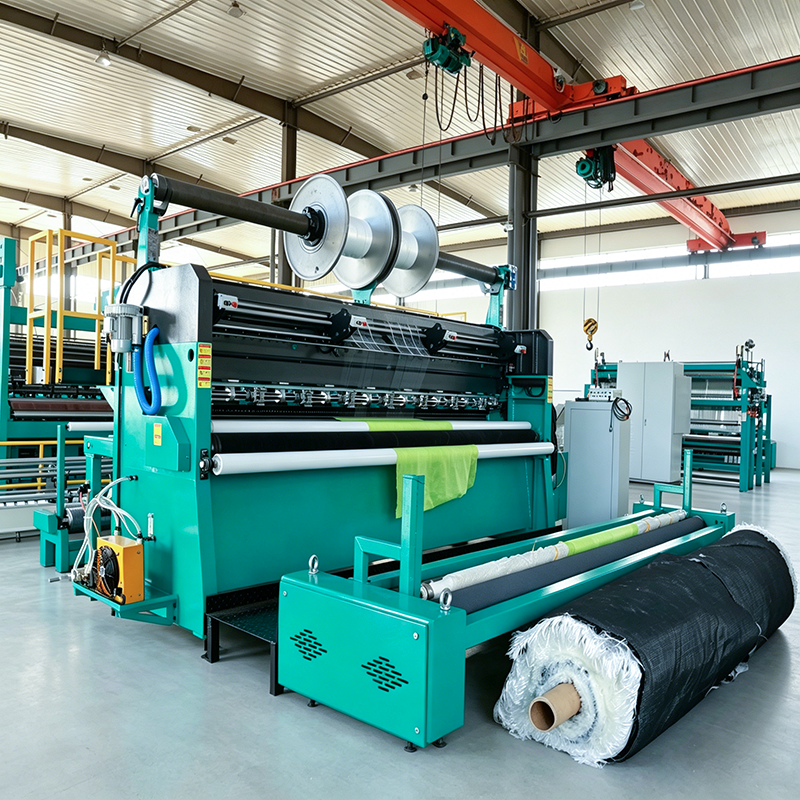
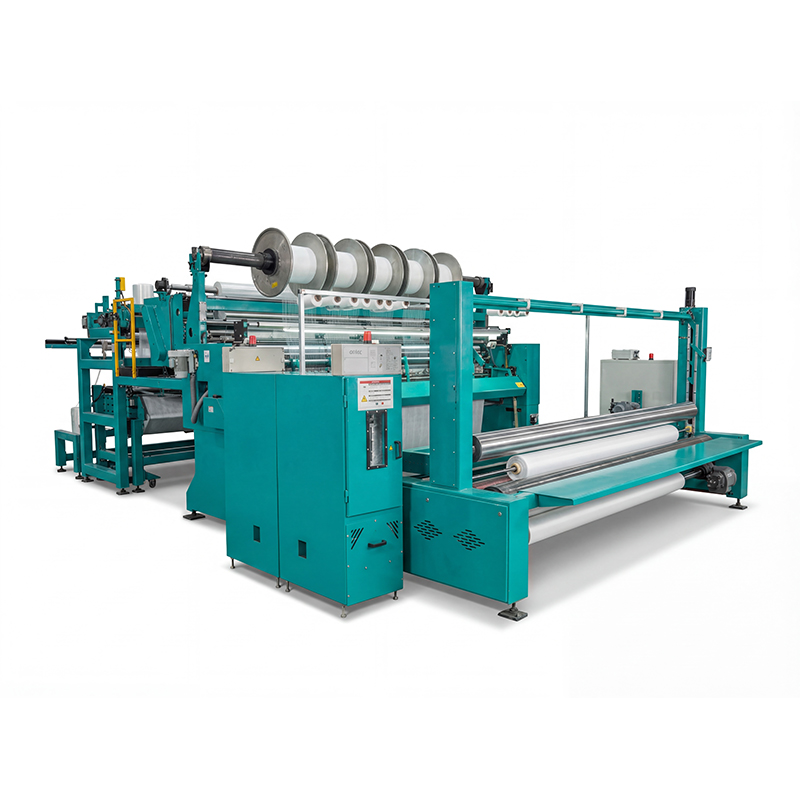
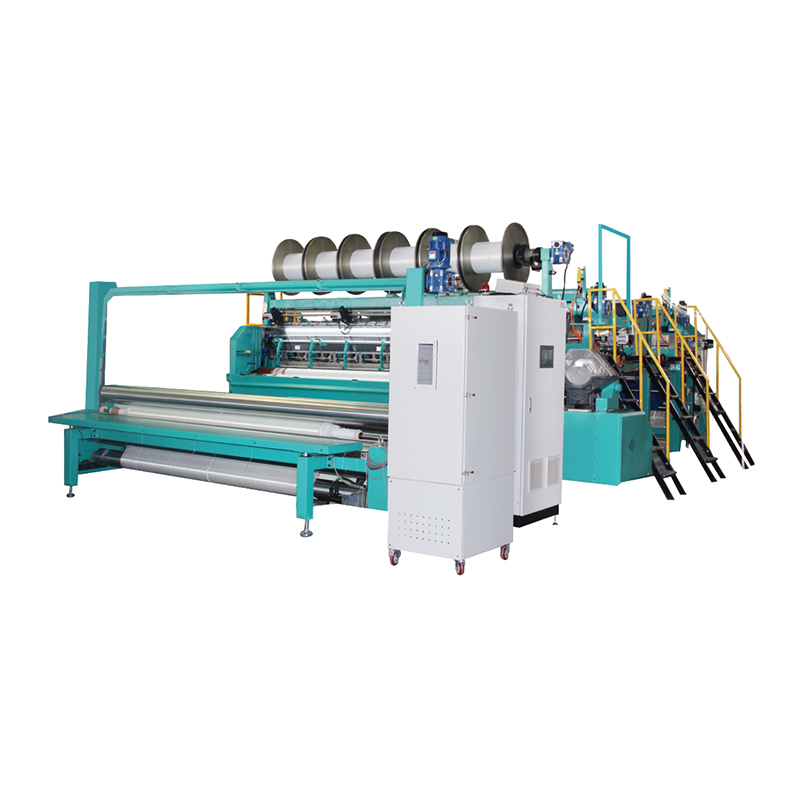
A stitch bonding machine is a warp knitting type machine that uses knitting needles and a stitching yarn to hold a web of fibers, a layer of chopped strands, or a layer of laid yarns together as one stable fabric. The needles pierce the layer, the stitching yarn forms knitted loops through it, and the loops lock the fibers in place without weaving and, in most cases, without glue, heat, or water. Because the stitches are made by warp knitting elements across the full width at the same time, the process runs continuously and can be set up for very different products.
Industry practice, including the Chinese textile industry standard FZ/T 97023, groups these machines mainly by the material they take in. The five common groups are:
- Web type: stitches a fiber web into a nonwoven fabric.
- Chopped strand mat type: stitches randomly laid chopped glass strands into a mat.
- Double chopped strand mat type: adds a second chopping unit so mats can be built in layers.
- Weft insertion type: stitches laid yarns or scrims, often for reinforcement fabrics.
- Terry cloth type: forms pile loops for towels and similar fabrics.
The rest of this guide explains how the process works, how the machine types differ, which specifications matter, and how to choose one.
How a Stitch Bonding Machine Works Step by Step
A stitch bonding machine looks like a conventional warp knitting machine, but it has a key difference. Instead of knitting a fabric from yarn alone, it knits through a material that is fed into the knitting zone, so the material becomes part of the finished fabric.
- Material feed: a fiber web, a layer of chopped strands, laid yarns, or another flat layer is delivered to the machine on a conveyor or from a feed unit. The layer must be even in weight and width, because any thin spot or gap will show up in the finished fabric.
- Stitching yarn supply: the stitching yarn comes from warp beams and passes through let off and tension control. It is usually a filament yarn, often in the range of 50 to 150 denier, chosen to suit the product.
- Needle penetration: the needle bar rises and falls, and the needles pass through the layer. Standard machines use compound needles, which close with a sliding element.
- Loop formation: guide bars place the stitching yarn around the needles, and the needles pull new loops through the old ones. Most machines carry one or two stitch forming guide bars.
- Holding and release: sinkers or similar elements hold the layer down while the needles retreat, so the material is not pulled back with them.
- Take down and batching: the stitched fabric is drawn forward at a set speed and wound into rolls. This speed sets the stitch length.
Stitch Type, Gauge, and Stitch Length
Three settings decide how the fabric looks and behaves. The first is the stitch type. Chain stitch, also called pillar stitch, forms straight columns of loops and gives strong lengthwise stability. Tricot stitch zigzags between neighbouring columns and gives a more closed, flexible structure. The second is gauge, the needle density, expressed as needles per inch. The third is stitch length, the distance between stitches along the fabric. Standard machines work with stitch lengths from about 0.5 mm to 5 mm.
Gauge and stitch length together set stitch density. For example, at gauge E10, which is 10 needles per inch or about 3.9 per centimetre, with a stitch length of 3 mm, there are about 3.3 stitch rows per centimetre. That gives roughly 13 stitches per square centimetre. A denser pattern holds a loose layer more firmly, but it uses more stitching yarn and perforates the material more, so the best setting depends on the product.
Five Types of Stitch Bonding Machines
| Machine Type | Material Fed In | Typical Products |
|---|---|---|
| Web type | Carded and cross lapped fiber web, sometimes with films or foams | Stitch bonded nonwoven, interlining, curtain fabric, medical bandage base, geotextile composites |
| Chopped strand mat type | Glass rovings cut into short strands | Chopped strand mat for composite molding and pultrusion |
| Double chopped strand mat type | Chopped strands from two units, with other layers between | Layered and combination mats |
| Weft insertion type | Laid yarns across and along the fabric | Laid scrims, reinforcement fabrics, grid structures |
| Terry cloth type | Pile yarn on a base fabric | Towels and terry fabrics |
Web Type Machines
A web type machine takes a fiber web produced by carding and cross lapping, or by other web forming methods, and consolidates it with stitches. Polyester, polypropylene, nylon, and blended fibers are common. The result is a nonwoven with good dimensional stability, used for interlining, curtain fabric, medical bandage base cloth, and as the backing layer in geosynthetic composites. Success depends on a uniform web, so the feed unit matters as much as the stitching head.
Chopped Strand Mat Machines
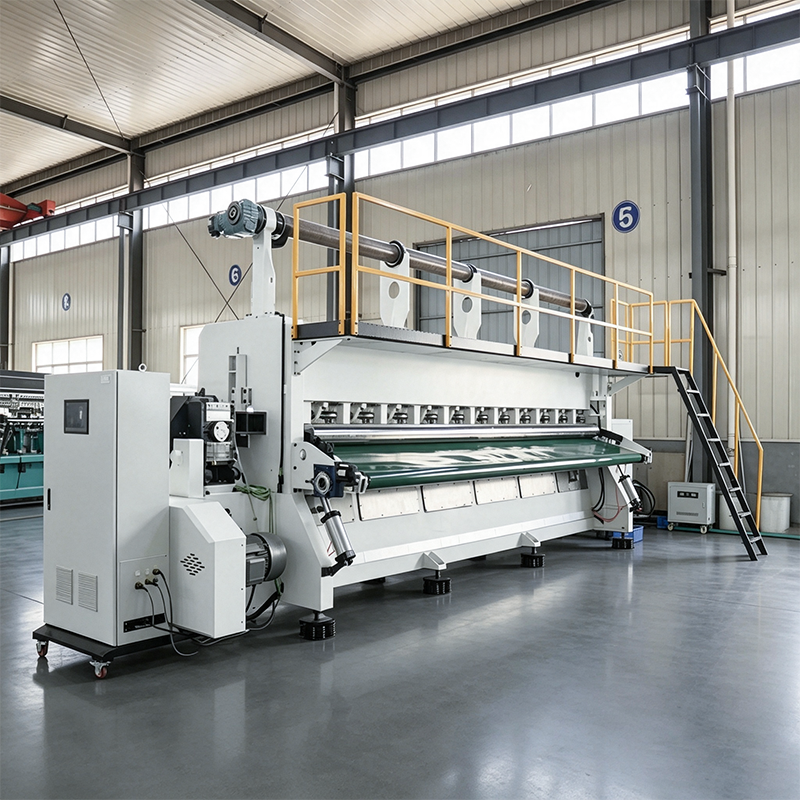
A chopped strand mat machine feeds glass rovings through a chopper that cuts them to a set length, commonly around 50 mm. The strands fall onto a moving belt in a random pattern and pass straight into the knitting zone, where stitching holds them together. The mat is then used as reinforcement in hand lay up, resin transfer, infusion, and pultrusion, in applications such as boat hulls, tanks, and vehicle panels. A double chopped strand mat machine adds a second chopping unit, so a mat can carry chopped layers on both sides of a central reinforcement, such as a roving or a veil, in a single pass.
Weft Insertion Machines
A weft insertion machine lays yarns across the width, and often along the length, before stitching them. Because the load carrying yarns stay straight, the fabric uses fiber strength efficiently. Typical products are laid scrims and grid like reinforcement fabrics. This is closely related to the biaxial and multiaxial machines used for composite reinforcement.
Terry Cloth Machines
The terry cloth type forms pile loops on a base fabric, creating the looped surface used in towels and similar products. It is the stitch bonding group that comes closest to a conventional pile knitting machine.
Stitch Bonding Compared With Other Bonding Methods
Stitch bonding is one of several ways to turn loose fibers into a fabric. The right choice depends on feel, strength, cost, and which layers must be joined.
| Method | How It Bonds | Strengths | Limits |
|---|---|---|---|
| Needle punching | Barbed needles entangle fibers | Thick felt like fabrics, no binder | Dense and often stiff, needle marks |
| Spunlace | High pressure water jets entangle fibers | Soft, drapeable, clean | Water and drying energy, fine web needed |
| Thermal bonding | Heat melts low melt fiber or powder | Bulky, simple, no yarn | Needs bondable fibers, heat input |
| Chemical bonding | Binder applied and cured | Wide range of fabrics | Binder handling, drying, emissions |
| Stitch bonding | Stitching yarn forms knitted loops through the layer | Joins different layers, stable, no binder or water | Visible stitch lines, stitching yarn cost |
The ability to join different materials is stitch bonding's special strength. The industry standard describes machines that can stitch webs, laid yarn layers, and nonwoven layers such as foams, plastic films, and metal foils, or combinations of them.
Key Specifications and What They Mean
When you compare data sheets, these are the numbers to read carefully. The ranges below are those given in the Chinese industry standard for stitch bonding machines, and individual manufacturers may offer machines outside them.
| Specification | Typical Range | What It Affects |
|---|---|---|
| Needle type | Compound needle | Reliability at speed, wear behavior |
| Gauge | E3.5 to E22 | Stitch density and the thickness of material that can be stitched |
| Stitch forming guide bars | 1 to 2 | Stitch pattern options |
| Working width | About 1.7 m to 4.4 m in the standard, up to about 6 m on large machines | Output per hour and product width |
| Stitch length | 0.5 mm to 5.0 mm | Fabric firmness and yarn consumption |
| Maximum mechanical speed | 500 to 2,000 revolutions per minute | Theoretical output |
Estimating Real Output
Maximum speed is not the same as output. One revolution of the main shaft normally forms one course, so speed in revolutions per minute is a count of stitch rows per minute. Dividing it by the stitch rows per centimetre gives fabric length per minute. A useful quick check for a chopped strand mat line is as follows. Take a width of 2.8 m, a mat weight of 450 grams per square metre, and a fabric speed of 10 metres per minute. That is 28 square metres a minute, which at 450 grams per square metre is 12.6 kilograms a minute, or about 756 kilograms an hour in theory. At 85 percent running efficiency the output is about 640 kilograms an hour. This is an illustration, not a promise for any machine, but the same method lets you compare quotations fairly.
Where Stitch Bonded Fabrics Are Used
- Composites: chopped strand mats and combination mats for marine, transport, tanks, pipes, and pultruded profiles.
- Construction and geosynthetics: composite geotextiles, reinforcement fabrics, and backing layers.
- Automotive: interior base fabrics, trim backing, and insulation layers.
- Apparel: interlining and structural linings.
- Home textiles: curtain fabric, towels, and terry products.
- Medical: bandage base cloth and other absorbent product substrates.
How to Choose a Stitch Bonding Machine
- Define the input material: fiber web, glass roving, laid yarns, pile yarn, or a combination. This decides the machine type.
- Define the product: weight per square metre, thickness, width, and strength requirements.
- Match gauge and stitch length: thicker or looser layers generally need a coarser gauge, finer layers a finer gauge.
- Choose the width: allow for edge trim, and match it to your finished roll width and cutting plan.
- Estimate output: use the method above with a realistic efficiency rather than maximum speed.
- Check the feed system: web feeding accuracy for web type machines, chopper accuracy and dust extraction for glass lines, and creel capacity for roving.
- Review the controls: servo driven let off and take down, adjustable stitch length, and monitoring that flags stitch faults early.
- Confirm support: installation, operator training, a needle and spare parts list, and a test run on your own material before shipment.
When asking for a quotation, send a fabric sample or a drawing, the input material and its weight, the target width, the required monthly output, the stitching yarn you intend to use, and your power supply. A supplier can then recommend a configuration instead of quoting a generic model.
Operating and Maintenance Tips
Stitch bonding machines run continuously, so small faults turn into long rolls of defective fabric. A regular routine keeps quality stable.
- Inspect needles, sinkers, and guides on a fixed schedule. Abrasive materials such as glass fiber wear them faster.
- Clear fiber dust and lint from the knitting zone and from the extraction system every shift.
- Check stitching yarn tension and keep beams and creels loaded consistently.
- Lubricate according to the manual, and keep spare needles on hand.
- Record faults and settings, so repeat problems can be traced to a cause.
| Symptom | Likely Cause | First Action |
|---|---|---|
| Skipped or dropped stitches | Worn or bent needle, timing drift, uneven yarn tension | Replace needles, check timing and tension |
| Waves or puckering | Take down speed or tension out of balance | Recalibrate take down and fabric tension |
| Thin or uneven mat weight | Chopper or web feed variation | Check feed unit, blades, and conveyor speed |
| Frequent needle breakage | Hard foreign matter, thick layer, misalignment | Inspect the layer, check alignment and setup |
| Stitching yarn breaks | Sharp guide edges, high tension, poor yarn | Check guides, lower tension, test the yarn |
Frequently Asked Questions
1. What is a stitch bonding machine?
It is a warp knitting type machine that stitches a fiber web, chopped strands, laid yarns, or other layers into a stable fabric using knitted loops of stitching yarn.
2. Is a stitch bonding machine the same as a sewing machine?
No. A sewing machine makes one line of stitches with a single needle and feed mechanism. A stitch bonding machine has hundreds or thousands of needles that form loops across the whole width at the same time, and it works continuously on rolls of material.
3. What materials can a stitch bonding machine process?
Fiber webs, chopped glass strands, laid yarns, and nonwoven layers such as foams, plastic films, and metal foils, or combinations of them. The machine type and setup must match the material.
4. How is stitch bonding different from needle punching?
Needle punching entangles fibers with barbed needles and uses no extra yarn. Stitch bonding uses a stitching yarn to form knitted loops through the layer, which can join different materials and gives a stable, controlled structure.
5. What products are made on stitch bonding machines?
Chopped strand mat and combination mats for composites, nonwoven interlining, curtain fabric, composite geotextiles, laid scrims, towels, terry fabrics, and medical base cloths.
6. What does gauge mean on a stitch bonding machine?
Gauge is the needle density, normally expressed as needles per inch. A finer gauge, such as E18 or E22, gives denser stitching, and a coarser gauge, such as E5 or E7, suits thicker, looser layers.
7. How do I estimate the output of a stitch bonding machine?
Divide the speed in stitch rows per minute by the stitch rows per centimetre to get fabric length per minute, then multiply by width and by a realistic efficiency. For mats, multiply by the weight per square metre to get kilograms per hour.
8. Can one machine run both glass fiber mat and polyester web?
Usually not without major changes. Chopped glass lines need a chopper, strand handling, and dust control, while web lines need a web feed system. Describe your material to the supplier before choosing a machine.
9. How often should needles be replaced?
There is no single interval. It depends on the material, speed, and running hours. Abrasive materials such as glass shorten needle life, so set an inspection schedule from your own experience and the manufacturer's manual, and replace needles at the first signs of wear.
10. What should I send a supplier to get an accurate quotation?
Send a fabric sample or drawing, the input material and its weight, target width, monthly output, stitching yarn, and power supply details. If possible, ask for a test run on your own material.
A stitch bonding machine binds fibers and layers into a stable fabric by knitting a stitching yarn through them. Choosing well means starting with the material you will feed in, then matching the machine type, gauge, stitch length, working width, and feed system to that material and to your output target. Estimate real output with a sensible efficiency figure, ask for a test run on your own material, and plan maintenance from the start.
Yuanyang Electromechanical builds warp knitting and stitch bonding machinery for specialty textile applications. Explore the ranges for chemical fiber textile and fiberglass textile, or contact us about a customized machine for your fabric.
News
-
What a Warp Knitting Machine Does A warp knitting machine turns hundreds or thousands of parallel yarns into a continuous fabric by looping each yarn around a needle and linking it to its neighbours a...
READ MORE -
Warp Knitting Machines: Machine Architecture, Yarn Control and Industrial Fabric Output Inside a warp knitting machine, every single yarn has its own itinerary. A thousand or more ends leave their be...
READ MORE -
What Is a Tricot Warp Knitting Machine A tricot warp knitting machine is a textile production machine that forms fabric by looping many parallel yarns fed from a warp beam, with each needle working i...
READ MORE -
A plant manager in Coimbatore sends the same specification to three suppliers: a 2.5 m biaxial warp knitting machine for glass fiber scrim, 0/90 laydown, 96-end creel, 2,200 m/hr target, installation...
READ MORE
-
Contact Info.
+86-198 5534 1617
+86-134 0158 3002yuanyang@yywarpknitting.com 699#, Shengzhi West Rd, Lvcheng Town, Danyang City, Zhenjiang City, Jiangsu Province, China

-
QR Code
-
Quick Links
Home About Products Manufacturing Customization News Contact -
Product List
Machine for Chemical Fiber Textile Machine for Fiberglass Textile Machine for Carbon Fiber Textile -
About Us
Company Profile Factory Gallery Value-added Service
Copyright © 2026 Changzhou Yuanyang Electromechanical Technology Co., Ltd. All Rights Reserved.
Custom Warp Knitting Machine Manufacturers
