

 English
 中文简体
 русский
 Français
 Español
 Deutsch

How Much Does a Textile Machine Cost? Real Price Bands, Budgets and TCO
2026-10-14
Content
- 1 Textile Machine Prices at a Glance
- 2 Six Variables That Move the Number Most
- 3 Why Two Quotes for the Same Machine Differ by 40 Percent
- 4 Where the Money Actually Goes
- 5 Segment by Segment: What Each Machine Type Costs
- 6 The Budget Beyond the Machine
- 7 Total Cost of Ownership Over Ten Years
- 8 Used Machines: What $80,000 Buys, and What It Costs Later
- 9 Budgeting by Application
- 10 Twelve Questions to Ask Before You Approve a Purchase Order
- 11 Payment Terms, Lead Time and Currency
- 12 Where Chinese-Built Machines Sit in the Price Landscape
- 13 Putting the Number Together
A plant manager in Coimbatore sends the same specification to three suppliers: a 2.5 m biaxial warp knitting machine for glass fiber scrim, 0/90 laydown, 96-end creel, 2,200 m/hr target, installation included. The three replies come back at $186,000, $342,000 and $611,000. None of the suppliers is lying, and none is obviously overcharging. The gap is built from the creel, the drive package, the control platform, the spare parts list, the commissioning days, the warranty length and the question of who pays for the foundation bolts, the riggers and the first set of needles.
That is the honest answer to the pricing question. Industrial textile machinery does not have a single price, because a "textile machine" is not a single product. A fiber web stitch bonding machine, a terry warp knitting machine, a multiaxial machine for carbon fiber and a powder scattering unit all sit in the same catalogue and all sit in wildly different price brackets. What you can do, however, is anchor yourself with reliable bands and then understand which levers move the number.
As a working summary: stitch bonding and fiber web machines for chemical fiber applications typically land between $35,000 and $280,000; biaxial warp knitting machines for glass fiber between $180,000 and $600,000; multiaxial machines between $450,000 and $1,800,000; carbon fiber multiaxial equipment from roughly $800,000 to $2,500,000; and complete scattering, web laying and short-cut fiber lines between $150,000 and $450,000. Those bands are for new machines, ex-works in Asia, before freight, duty, foundation work, installation and training.
Textile Machine Prices at a Glance
The table below is the fastest way to place yourself on the map. The ranges assume a standard configuration with a mainstream control platform, a single shift of factory acceptance testing, a 12-month warranty and a modest spare parts package. Anything outside that baseline moves the number, usually upward.
| Machine category | Typical new price (USD) | Typical lead time | Main price driver |
|---|---|---|---|
| Stitch bonding / fiber web machine, 1.2-2.5 m | 35,000-160,000 | 60-120 days | Working width, needle density, line speed |
| High-speed stitch bonding, 2.5-3.4 m | 120,000-280,000 | 90-150 days | Speed, beam count, servo drive quality |
| Biaxial warp knitting, glass fiber, 2.5-3.3 m | 180,000-600,000 | 120-180 days | Creel size, short-cut units, laydown angles |
| Multiaxial warp knitting, glass or carbon | 450,000-1,800,000 | 150-240 days | Number of layers, tension control, fiber type |
| Carbon fiber multiaxial, 0/90/+45/-45 | 800,000-2,500,000 | 180-300 days | Creel design, tension tolerance, qualification support |
| Powder scattering plus web laying line | 150,000-450,000 | 90-150 days | Width, dosing accuracy, dust extraction |
| Terry / towel warp knitting machine | 90,000-350,000 | 90-150 days | Gauge, number of guide bars, pile height control |
| Auxiliary: warp beams, inspection, packing | 8,000-60,000 | 30-60 days | Automation level, beam diameter, fabric width |
Read the ranges as bands of probability, not as a price list. A 2.5 m biaxial machine with a 48-end creel, manual doffing and a basic HMI sits at the bottom of its band. The same frame with a 144-end creel, individual end tension monitoring, automatic edge trimming, a laser safety scanner and an OPC-UA data link sits at the top, and the mechanical frame between them may be almost identical.
Six Variables That Move the Number Most
Working width
Width is the first question every supplier asks, and for good reason. Going from 1.5 m to 3.0 m does not double the price; it typically adds 45 to 70 percent, because the frame and beams scale linearly while the drive, control cabinet and software stay largely fixed. The practical consequence is that wider is cheaper per square meter of output, but only if you can sell or consume the extra fabric. A converter running 400 tonnes a year rarely needs 3.3 m.
Line speed and needle density
Speed is a function of mass in motion. A machine rated at 2,000 m/hr and one rated at 2,600 m/hr may share a frame, but the faster unit carries stiffer beams, better-balanced shafts, higher-grade bearings and a servo package with more headroom. Expect 15 to 30 percent on price for that jump. Needle density and gauge behave similarly: finer gauge means more needles per inch, tighter tolerances and a higher consumable cost per running meter.
Material family
Glass fiber is abrasive. Carbon fiber is abrasive, conductive and expensive to scrap. Machines handling glass need hardened yarn contact surfaces and robust dust management; machines handling carbon need static dissipation, gentler tension control and tighter fiber spread. The machine architecture may look similar, but a carbon-capable multiaxial unit typically costs 30 to 60 percent more than the glass version of the same width. The machines used for fiberglass, chemical fiber and carbon fiber differ in more than paint color.
Creel and fiber handling
The creel is the most under-budgeted item in the whole project. A basic 48-position package creel might add $25,000; a 144-end creel with individual tension rollers, broken-end detection and pneumatic threading can add $120,000 to $180,000. On carbon lines, where a single damaged tow can cost more than a day of machine time, the creel and its sensors are not optional extras.
Control platform and automation
A standalone PLC with a touch panel is not the same as a closed-loop system with recipe management, remote diagnostics, production reporting and a validated data interface to the plant MES. The price difference is usually $18,000 to $60,000, but the real value appears in changeover time and in how quickly a technician can diagnose a fault at 2 a.m.
Build standard and component brands
Bearings, gearboxes, servos, pneumatic valves and safety relays carry brand premiums that can total 8 to 15 percent of machine value. Some of that premium is worth paying, particularly on continuously running drives. Some of it is habit. Ask for the component list by brand and model, and compare it line by line rather than accepting "premium components" as a phrase in a brochure.
Why Two Quotes for the Same Machine Differ by 40 Percent
Once the machine itself is comparable, the remaining gap comes from commercial scope. Before you conclude that one supplier is 40 percent cheaper, check which of the following are inside the price.
- Incoterm: ex-works, FOB, CIF or delivered with duty paid.
- Installation and commissioning days, and who pays for the engineers' flights, visas, hotels and per diem.
- Foundation drawings, anchor bolts, grouting and levelling plates.
- Electrical cabinet scope: does the supplier stop at the terminal box or run cable to your MCC?
- Spare parts package for the first year, typically 3 to 6 percent of machine value.
- Warranty length, and whether it covers consumables such as needles and belts.
- Operator training: three days on site versus two weeks including a classroom module.
- Documentation: an operation manual versus a full set with electrical schematics, PLC backups and maintenance schedules.
- Performance guarantee: is there a written acceptance test with speed, efficiency and fabric quality criteria?
- Currency and payment terms: a 30/70 split against a 20/80 split with a 24-month deferred balance is not the same price.
A $180,000 ex-works machine and a $250,000 delivered-and-commissioned machine can represent identical value. The problem is that procurement systems often compare the headline number, and the cheapest headline is usually the one with the most exclusions. Insist on a common scope template before the commercial comparison starts.
Where the Money Actually Goes
Understanding the internal cost structure helps you negotiate sensibly. If you ask for a 15 percent discount on a machine whose margin is already 10 percent, the supplier will recover it somewhere: thinner frame steel, a lower-grade gearbox, fewer commissioning days, or a slower spare parts response. The table below shows how a typical $300,000 biaxial machine is assembled.
| Cost element | Share of selling price | What it covers |
|---|---|---|
| Frame, beams and mechanical structure | 18-25% | Welded frame, stress relief, machining, warp beams, rollers |
| Needle system and guide bars | 12-18% | Needle beds, guide bars, pattern drives, precision alignment |
| Drive and servo package | 10-15% | Main drive, servo motors, gearboxes, braking |
| Control, HMI and software | 8-12% | PLC, motion control, recipe management, safety logic |
| Creel and fiber feeding | 10-20% | Creel frame, tensioners, end detection, threading aids |
| Assembly, testing and commissioning | 8-12% | Assembly labor, factory acceptance test, site service |
| Overhead, warranty and margin | 10-15% | Engineering, quality, administration, warranty reserve, profit |
Two observations follow. First, roughly 60 percent of the cost is bought-in content and material, so raw material and component price movements pass through to you with a lag of one to two quarters. Second, the only line where a supplier can trim meaningfully without harming the machine is overhead and margin, which is exactly why discounts beyond 8 percent usually come with a scope change.
Segment by Segment: What Each Machine Type Costs
Stitch bonding and fiber web machines
This is the most accessible entry point into warp knitting technology. A fiber web stitch bonding machine in the 1.2 to 2.5 m class typically costs $35,000 to $120,000 and is used for nonwoven reinforcement, wipes substrates, interlinings, coating backings and technical felts. The high-speed variant, running 2.5 to 3.4 m with heavier beams and better dynamic balance, moves to $120,000 to $280,000. The premium buys production rate and stability at speed, not a different process.
For buyers replacing a 15-year-old stitch bonding line, the calculation is straightforward. If the old machine runs at 700 m/hr and the new one at 1,300 m/hr with fewer breaks, the payback often arrives within 24 to 30 months on two-shift operation, before any energy savings are counted.
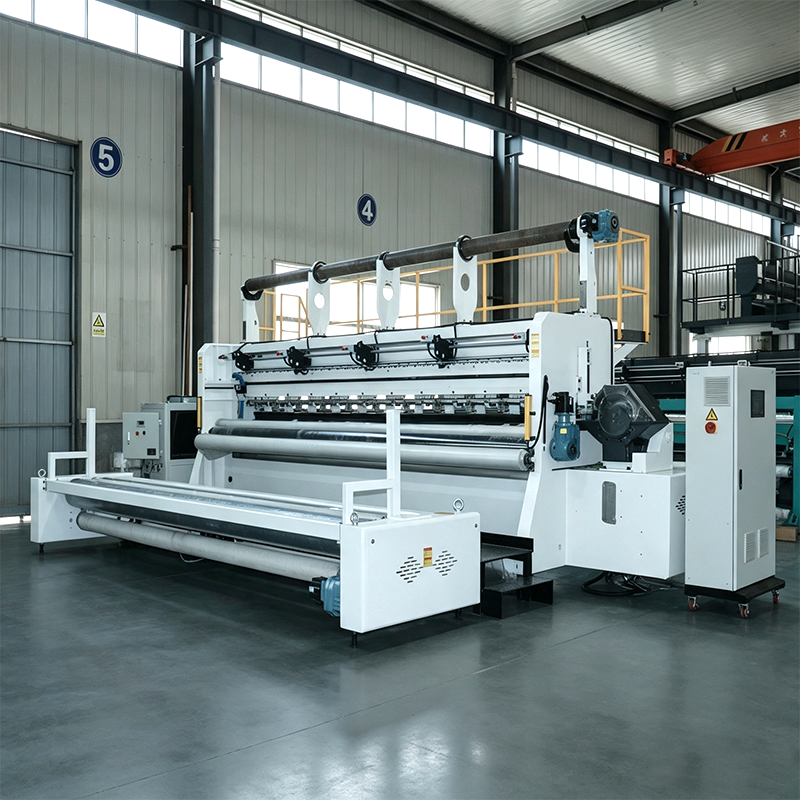 YHS High Speed Stitch Bonding Machine for Chemical-Fiber WebsHigh-speed stitch-bonding option for loose or pre-stitched chemical-fiber webs, with 4,400 mm working width and speeds up to 2,000 r/min; relevant when replacing older lines.View Product →
Biaxial warp knitting machines
Biaxial machines produce 0/90 fabrics for geogrids, geotextiles, scrims, roofing membranes and composites. Entry-level glass configurations start near $180,000; a 3.3 m machine with a large creel, short-cut fiber units and inline inspection reaches $600,000. Within that band, the YRS3MG configuration for mesh geogrid and the YRS3MM configuration for mesh geotextile sit at different points because their needle arrangements and weft insertion systems serve different products, not because one is intrinsically better.
Multiaxial warp knitting machines
Multiaxial machines add diagonal layers at +45 and -45 degrees, and sometimes additional angles, producing reinforcement fabrics for composites. Pricing steps up sharply because layer count multiplies the mechanical complexity: a four-layer 0/90/+45/-45 machine typically costs $450,000 to $1,200,000 in glass configuration. The cost of the creel, the number of fiber guidance paths and the tension consistency across 400 or more ends often exceeds the cost of the knitting head itself.
The YRS33M family covers glass and general multiaxial production, while the YRS33MC is a dedicated carbon fiber multiaxial platform. On the carbon version, the price premium of 30 to 60 percent over an equivalent glass machine is defensible on one ground only: scrap rate. A carbon line producing 500 tonnes a year with a 2 percent scrap reduction saves more than the premium in the first year at typical tow prices.
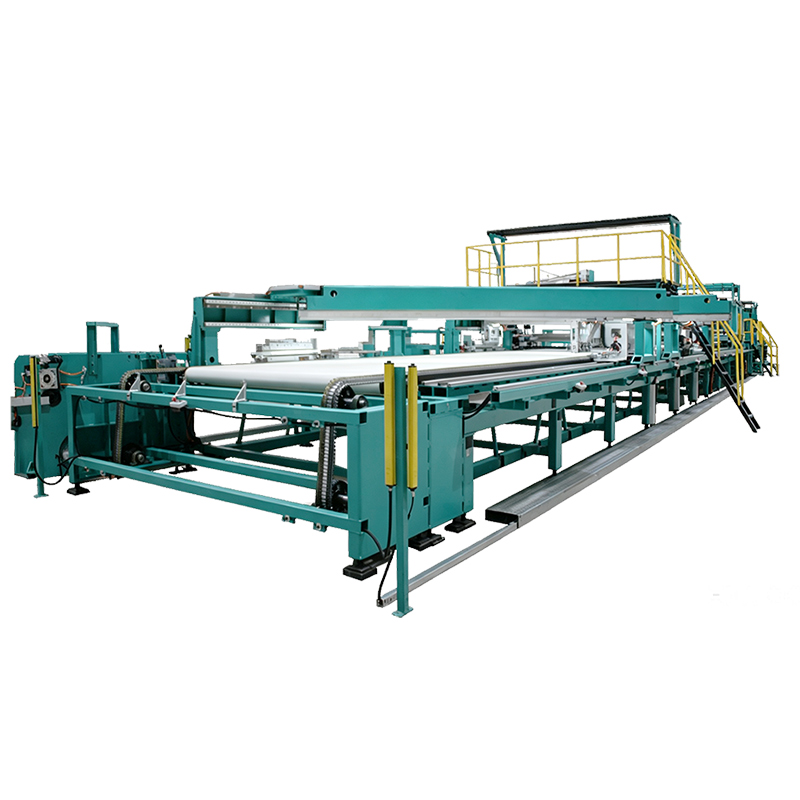 YRS3-3M-C Carbon Fiber Multi-Axial Warp Knitting MachineDedicated carbon-fiber multiaxial platform for multilayer, multi-angle weft laying in one step; available in 1,270 mm and 2,540 mm widths for structural composite fabrics.View Product →
Buyers building composite reinforcement capacity for wind blades, pressure vessels or automotive parts should budget $800,000 to $2,500,000 for a carbon-capable machine depending on width, layer count and creel sophistication, and should separate the machine from the qualification work that follows it.
Powder scattering and web laying equipment
Scattering and laying units are usually bought as part of a line rather than standalone. An automatic powder scattering machine in the 1.6 to 2.6 m class runs $60,000 to $180,000 depending on dosing accuracy and dust extraction. A weft insertion or rotary laid scrim machine is generally $90,000 to $260,000. When these are integrated with a biaxial knitting machine, the line price is not the sum of the parts: shared frames, shared controls and shared safety systems usually reduce the total by 10 to 15 percent compared with buying separately.
Chopped fiber and specialty configurations
Chopped fiber units add $40,000 to $140,000 to a base machine, with double-chopped configurations at the upper end. These are niche products where the supplier's process knowledge matters more than the bill of materials, and where a lower quotation often reflects a supplier who has not built many of them.
The Budget Beyond the Machine
New buyers consistently under-budget the surrounding costs, and that is where projects overrun. The rule of thumb is to add 20 to 35 percent to the machine price for a domestic installation, and 30 to 50 percent for an import into a market with duty and long inland logistics.
| Cost item | Typical share of machine price | Notes |
|---|---|---|
| Ocean freight and insurance | 3-8% | Depends on volume, route and container availability |
| Import duty and clearance | 0-12% | Varies by country and by machine classification |
| Inland transport and rigging | 1-3% | Crane capacity and access width often set the cost |
| Foundation and civil works | 2-6% | Vibration isolation, pits, cable trenches |
| Power supply and compressed air | 1-4% | Transformer capacity, cabling, dryers, receivers |
| Installation and commissioning | 4-10% | Includes engineer travel and accommodation |
| Operator and maintenance training | 1-3% | Higher if training happens at the supplier's factory |
| First-year spare parts | 3-6% | Needles, belts, bearings, sensors, filters |
| Certification and compliance | 0.5-2% | CE marking, local electrical inspection, safety audit |
| Ramp-up working capital | 5-10% | Raw fiber inventory and finished goods before cash returns |
A $320,000 machine imported into a market with 8 percent duty, a five-week sea leg and a two-week commissioning therefore represents a project of roughly $420,000 to $450,000 before the first meter of saleable fabric. Approving the machine and discovering the rest later is the most common cause of a stalled installation.
Total Cost of Ownership Over Ten Years
The purchase price is the smallest number in the calculation that matters. Take a $320,000 biaxial machine with a 45 kW average power draw, running 6,000 hours a year on two shifts, in a plant paying $0.09 per kWh.
- Capital cost including freight, duty and installation: approximately $386,000.
- Electricity: 270,000 kWh a year, or about $24,300 annually.
- Maintenance at 3 percent of capital per year: about $11,600.
- Consumables such as needles, oil, belts and filters: $8,000 to $12,000 a year.
- Two operators and a part-time technician: $50,000 to $60,000 a year.
- Floor space of about 250 square meters at $60 per square meter per year: $15,000.
Over ten years, undiscounted, that totals roughly $1.35 million, of which the machine and its installation account for about 28 percent. Energy, labor and maintenance dominate. This reframes the negotiation: a 6 percent saving in annual energy consumption or a 3 percent improvement in uptime is worth more than a 5 percent discount on the invoice.
Uptime deserves particular attention because it is invisible in a quotation. A machine running 85 percent of scheduled time versus 92 percent loses about 420 hours a year, which at 1,800 m/hr and a fabric value of $1.20 per meter represents more than $900,000 of unrealized output. That is why spare parts availability, remote diagnostics and a supplier's response time belong in the commercial comparison, not in a footnote.
Used Machines: What $80,000 Buys, and What It Costs Later
A used biaxial warp knitting machine from the 2008-2013 period typically sells for $80,000 to $160,000 depending on width and condition. A used multiaxial machine of similar age runs $180,000 to $400,000. On paper, the savings against new equipment are 50 to 65 percent. In practice, the gap narrows quickly.
Expect refurbishment to cost $40,000 to $90,000 for mechanical work: needle beds, guide bars, beam straightness, drive rebuilds and paint. A control retrofit, if the original platform is obsolete, adds $25,000 to $60,000 and can take twelve weeks. Documentation is often missing, which means reverse engineering the electrical schematic at $90 an hour. Safety compliance to current standards may require guarding, interlocks and a risk assessment.
The larger risk is strategic. Older machines were designed around a narrower range of fiber types and narrower fabrics. If your product roadmap includes carbon or heavier glass architectures, a used machine may technically run the material but produce inconsistent tension and a scrap rate that quietly consumes the savings. Used equipment makes sense when the product is stable, the technical documentation exists, and you have in-house maintenance capability. It makes poor sense as a platform for a new product line.
Budgeting by Application
Application-driven budgets are more useful than machine-driven ones, because buyers think in terms of the product they must ship, not the frame they must buy.
- Geogrid and geotextile production: an integrated line with biaxial knitting, weft insertion and inline inspection typically requires $450,000 to $900,000, including a 96 to 144-end creel.
- Glass fiber scrim and roofing membrane substrate: a mid-width biaxial machine with a moderate creel sits at $220,000 to $380,000, plus $40,000 to $70,000 for ancillaries.
- Carbon fiber multiaxial reinforcement for composites: budget $1.2 to $2.5 million for the machine, creel and services, and a further $80,000 to $200,000 for qualification trials and material testing.
- Nonwoven and wipes substrate reinforcement: a stitch bonding line from $60,000 to $180,000 depending on width and speed, often the fastest payback in the catalogue.
- Toweling and home textiles: a terry warp knitting machine in the $120,000 to $350,000 range, with the upper end reflecting finer gauge and more guide bars.
Note how wide the ranges are even within a single application. The width of the product, the target output, the acceptable scrap rate and the level of automation all push the number. A useful discipline is to fix the product specification first, then let the machine configuration follow, rather than shopping machines and searching for a product afterwards.
Twelve Questions to Ask Before You Approve a Purchase Order
Most costly misunderstandings are avoidable with a checklist. These twelve items separate a comparable quotation from a persuasive one.
- What exactly is the scope of supply, line by line, including everything not listed?
- What is the guaranteed output in meters per hour at the specified fiber and fabric weight, and how is it verified?
- What is the acceptance test procedure, and who pays for materials used during it?
- Which components are branded, and which are supplier-manufactured or sourced locally?
- What is the creel capacity, tension tolerance per end, and broken-end detection method?
- What is the warranty period, what does it exclude, and what is the response time commitment?
- How many commissioning days are included, and what happens if commissioning runs longer?
- What spare parts are recommended for two years of operation, and what do they cost?
- Which wear parts need replacement within three years, and what is their unit price?
- What documentation is delivered: manuals, electrical schematics, PLC backups, parameter lists?
- What is the payment schedule, and is any portion tied to performance acceptance?
- Can the supplier provide two reference customers running a similar product, with contact details?
The twelfth question is the one buyers skip most often. A supplier who has built twenty machines for your specific application will answer process questions without hesitation. A supplier who has built two will answer with specifications. The difference matters more than a 4 percent price gap.
Payment Terms, Lead Time and Currency
Standard terms for Asian-built industrial textile machinery are 30 percent deposit with the order and 70 percent before shipment, often secured by a letter of credit at sight. Some suppliers offer 20/70/10 with the final balance released after acceptance; that structure is worth negotiating because it aligns the supplier's cash with your commissioning schedule. Expect it to be priced into the quotation, typically 1 to 3 percent.
Lead times in the current market run 60 to 120 days for stitch bonding and fiber web machines, 120 to 180 days for biaxial machines, and 150 to 300 days for multiaxial and carbon platforms. Add four to eight weeks for ocean freight, port clearance and inland delivery. A realistic project timeline from purchase order to first saleable fabric is therefore six months for a simple line and twelve months for a carbon-capable multiaxial installation.
Currency exposure is frequently ignored. A machine quoted in euros can move 6 to 9 percent against the dollar within a single lead time. If the contract is not in your functional currency, either fix the exchange rate at order or build a 10 percent contingency into the approved budget. For a $600,000 machine, that is a $60,000 line item that deserves a decision rather than a surprise.
Where Chinese-Built Machines Sit in the Price Landscape
European and Japanese multiaxial and biaxial machines remain the benchmark for the highest speed and the most demanding composite qualifications, and their prices reflect it: a comparable European multiaxial line can cost two to three times the Asian figure for similar width and layer count. Chinese manufacturers occupy the middle and lower-middle of the market, with prices typically 35 to 60 percent below European equivalents for glass fiber applications.
That position has changed in character over the past decade. Companies such as Changzhou Yuanyang Electromechanical Technology, operating under the Danyang Yixun banner and active since 2008, build dedicated ranges for chemical fiber, glass fiber and carbon fiber rather than a single generic platform. The chemical fiber catalogue covers fiber web stitch bonding, high-speed stitch bonding, terry knitting and biaxial machines; the glass fiber range spans chopped fiber units, laid scrim machines, powder scattering, multiaxial machines, mesh geogrid and geotextile configurations; and the carbon range is built around dedicated multiaxial equipment. Custom engineering for special machines and high-precision warp knitting components is part of the offer.
What this means for a buyer is that the entry price of $180,000 to $400,000 for a glass biaxial machine is not a compromise on the frame. It usually reflects a shorter options list, a local control platform and a smaller creel. The sensible purchasing approach is to compare the specification against your product requirements, ask for the component brand list, and check whether the supplier can support the machine in your region for the next ten years. A cheaper machine from a supplier with no service footprint is expensive; a well-specified machine from a supplier who answers technical questions in detail is cheap at almost any point in the range.
Putting the Number Together
If you need a single planning figure, use this: budget 30 to 50 percent above the machine price for a complete installation, expect the machine itself to represent under a third of the ten-year cost of ownership, and treat the creel, the control platform and the spare parts package as the three line items most likely to change your quote without changing your production capability.
Price bands help you screen suppliers, but they do not choose one. The useful conversation starts when you can state your fabric weight, your target output, your fiber type, your width and your acceptable scrap rate. At that point, two machines that looked identical in a brochure become visibly different in a quotation, and the $186,000 and $611,000 replies start to make sense.
News
-
What Is a Tricot Warp Knitting Machine A tricot warp knitting machine is a textile production machine that forms fabric by looping many parallel yarns fed from a warp beam, with each needle working i...
READ MORE -
Warp Knitting Machines: Machine Architecture, Yarn Control and Industrial Fabric Output Inside a warp knitting machine, every single yarn has its own itinerary. A thousand or more ends leave their be...
READ MORE -
Three quotations land on the same desk for the same polyester nonwoven line, and on paper they look interchangeable. Each is priced per metre of working width. Each quotes a similar top speed. Each c...
READ MORE -
Have you ever wondered why some weaving looms operate flawlessly for decades, while others seem to suffer from constant breakdowns and quality issues? The secret isn’t luck; it’s a disciplined and str...
READ MORE
-
Contact Info.
+86-198 5534 1617
+86-134 0158 3002yuanyang@yywarpknitting.com 699#, Shengzhi West Rd, Lvcheng Town, Danyang City, Zhenjiang City, Jiangsu Province, China

-
QR Code
-
Quick Links
Home About Products Manufacturing Customization News Contact -
Product List
Machine for Chemical Fiber Textile Machine for Fiberglass Textile Machine for Carbon Fiber Textile -
About Us
Company Profile Factory Gallery Value-added Service
Copyright © 2026 Changzhou Yuanyang Electromechanical Technology Co., Ltd. All Rights Reserved.
Custom Warp Knitting Machine Manufacturers
