

 English
 中文简体
 русский
 Français
 Español
 Deutsch

Machine for Chemical Fiber Textile: How to Choose the Right Warp Knitting Line
2026-09-23
Content
- 1 The Short Answer: Fiber First, Fabric Second, Everything Else Third
- 2 What Actually Counts as a Machine for Chemical Fiber Textile
- 3 Stitch-Bonding Machines: Where Most Chemical Fiber Projects Start
- 4 Biaxial Warp Knitting: When the Fabric Needs Directional Strength
- 5 Terry and Towel Production on Chemical Fiber Yarns
- 6 Matching Working Width, Gauge, and Configuration to Your Product Mix
- 7 The Specification Sheet Checklist: Numbers to Get in Writing
- 8 Where Chemical Fiber Projects Actually Go Wrong
- 9 Speed, Efficiency, and Realistic Output Calculations
- 10 Installation, Commissioning, and the First Ninety Days
- 11 Maintenance, Spare Parts, and Consumables
- 12 Cost Structure: Where the Money Goes Over Five Years
- 13 Choosing a Manufacturing Partner, Not Just a Machine
- 14 Customisation and Special Equipment: When the Standard Model Is Not Enough
- 15 Questions to Put in the Inquiry Before You Request a Price
Three quotations land on the same desk for the same polyester nonwoven line, and on paper they look interchangeable. Each is priced per metre of working width. Each quotes a similar top speed. Each comes with a folder of photographs and a list of reference plants. One is a stitch-bonding machine, one is a biaxial warp knitting machine, and one is a raschel machine with weft insertion. They are not interchangeable. The first consolidates a loose carded web by knitting a bonding yarn straight through it. The second builds a fabric from two perpendicular sheets of yarn. The third sits somewhere between the two and is often quoted for the wrong job precisely because it looks versatile on a brochure page.
The short answer, before the reasoning: for chemical fiber textile production your machine is defined by three things in a fixed order — the fiber you actually run, the fabric architecture you actually sell, and the finishing route your customer actually uses downstream. Working width, gauge, and speed come after those three and should always be negotiated as ranges rather than single headline numbers. Purchase price comes last, and only once the five-year picture is on the table. Get the first three right and the project usually succeeds even with an average supplier. Get them wrong and no amount of operator skill, spare needles, or after-sales goodwill will recover the margin.
What follows is the reasoning behind that conclusion, the numbers worth putting in a contract, the failure modes that show up eighteen months after commissioning, and a practical way to compare suppliers who all claim to build "a machine for chemical fiber textile."
The Short Answer: Fiber First, Fabric Second, Everything Else Third
Chemical fiber is a family, not a material. The list a machine has to survive includes polyester (virgin PET and increasingly recycled rPET from bottle flake), polyamide 6 and 66, polypropylene, acrylic, viscose and rayon, PBT, and blends of these with cotton or wool. They behave differently in ways that matter at 900 needles per metre running at speed. Melting point decides how much friction heat the yarn path can tolerate. Moisture regain decides static behaviour and whether the web clings to the feed rollers. Tenacity and elongation decide how much tension the yarn sheet can carry before filaments break. Spin finish type and level decide how much residue builds up on guides, needles, and sinkers over a shift. Crimp and staple length decide how the carded web behaves when it enters the stitching zone.
Fiber form then decides the feed section. A carded staple web arrives as a batt and needs controlled compression and edge guidance. A filament warp sheet arrives as hundreds or thousands of parallel ends on beams and needs per-group tension control. Tow, split-film tape, and spunbond roll goods each need their own unwind logic. A machine configured for one of these will technically accept the others and will produce saleable fabric at a fraction of its rated speed.
Fabric architecture decides the machine family, and this is where most sourcing mistakes begin. Table 1 maps the common chemical fiber products to the machine class that normally produces them and the specification the buyer has to nail down first.
| Fabric you sell | Fiber input | Machine class | Fix this first |
|---|---|---|---|
| Wipe, hygiene, and interlining substrate | PET or PP staple web | Fiber web stitch-bonding machine | Web weight range and bonding yarn count |
| High-volume light consolidation cloth | PP or PET web | High-speed stitch-bonding machine | Sustainable line speed at your web weight |
| Banner, tarpaulin, and reinforcement scrim | PET or PA filament | Biaxial warp knitting machine | Weft density range and yarn linear density |
| Towel, terry cloth, and cleaning textile | PET, microfibre, or blended yarn | Towel and terry warp knitting machine | Pile height and loop density |
| Mesh, geo-grid, and composite carrier | PET, PP, or glass filament | Raschel biaxial and mesh machines | Mesh geometry and strength class |
A useful rule of thumb: if the strength of the finished fabric depends mainly on how the web was consolidated, you are buying a stitch-bonding machine. If strength depends on yarns crossing at a controlled angle, you are buying a biaxial or multiaxial warp knitting machine. If the selling point is surface, you are buying a terry machine. Choosing across these boundaries because one supplier quoted lower is the single most expensive mistake in this category.
What Actually Counts as a Machine for Chemical Fiber Textile
The phrase describes a configuration, not a category. The same machine frame can be built for chemical fiber, fiberglass, or carbon fiber, and the differences are concentrated in a handful of engineering decisions that a quotation rarely spells out.
Glass filament is abrasive and brittle. It wears guide elements, it snaps rather than bends, and it demands surface treatments and radii that would be unnecessary for polyester. Carbon tow must not be damaged at all; the yarn path is designed around spread tow, minimal contact, and tension uniformity, and every sharp bend is a quality defect waiting to happen. Chemical fiber sits in a third place: thermoplastic, sensitive to friction heat, prone to static, and supplied with a spin finish that gradually contaminates everything it touches.
So a machine genuinely configured for chemical fiber handling is recognised by a few specific features rather than by a label on the frame.
- Yarn path geometry with generous radii and low wrap angles, so that friction heat per contact point stays low at production speed.
- Tension control at group level or individual end level, with a measurable and repeatable set point rather than a hand-tightened disc.
- Static dissipation through conductive components and controlled humidity assumptions written into the installation manual.
- Guide, needle, and sinker metallurgy and coating selected for thermoplastic filament rather than for abrasion resistance alone.
- Extraction and cleaning access sized for spin finish residue and fiber fly, not for a single weekly wipe-down.
- Drive and control resolution fine enough to hold stitch density and weft density within the tolerance you promise your customer.
Ask a supplier to state which of these are standard and which are options, and to name the fiber types each option was validated on. A vague answer here predicts a difficult commissioning.
Stitch-Bonding Machines: Where Most Chemical Fiber Projects Start
Stitch-bonding is the shortest route from loose fiber to saleable roll goods. A carded web enters the stitching zone, a filament bonding yarn is knitted through the full thickness of the web, and the fabric exits consolidated with no chemical binder, no thermal bonding, and no drying oven. The consequences follow directly from that mechanism. There is nothing to cure, so energy cost per metre is low. There is no latex or powder, so the material is suitable for applications where binder chemistry is a problem. Strength is modest compared with a woven or laid-scrim reinforcement, and elongation in the machine direction is comparatively high, which is either a feature or a defect depending on what the customer is buying.
Three machine variables decide what you can sell. Stitch density, expressed as courses per centimetre, sets the bonding intensity and therefore the hand and the tensile profile. Gauge, expressed as needles per inch, sets how fine the bonding structure can be. The number of guide bars sets how many yarn systems can be combined — a two-bar configuration covers most standard work, while additional bars open up pattern effects, inlay yarns, and more complex structures. Working width in this class typically runs from around 2.4 m up to about 4.6 m, with wider machines built on request.
The output side is wide. The same machine family produces cleaning cloth substrates, medical and hygiene wipe material, interlining for garment manufacture, mattress and upholstery backing, shoe lining, cable wrapping tape, agrotextile, and lighter geotextile grades. That breadth is a genuine advantage for a converter with several customers, and also a trap: a machine tuned for one end of the range will not deliver the same economics at the other end without a change of bonding yarn, needle selection, and speed.
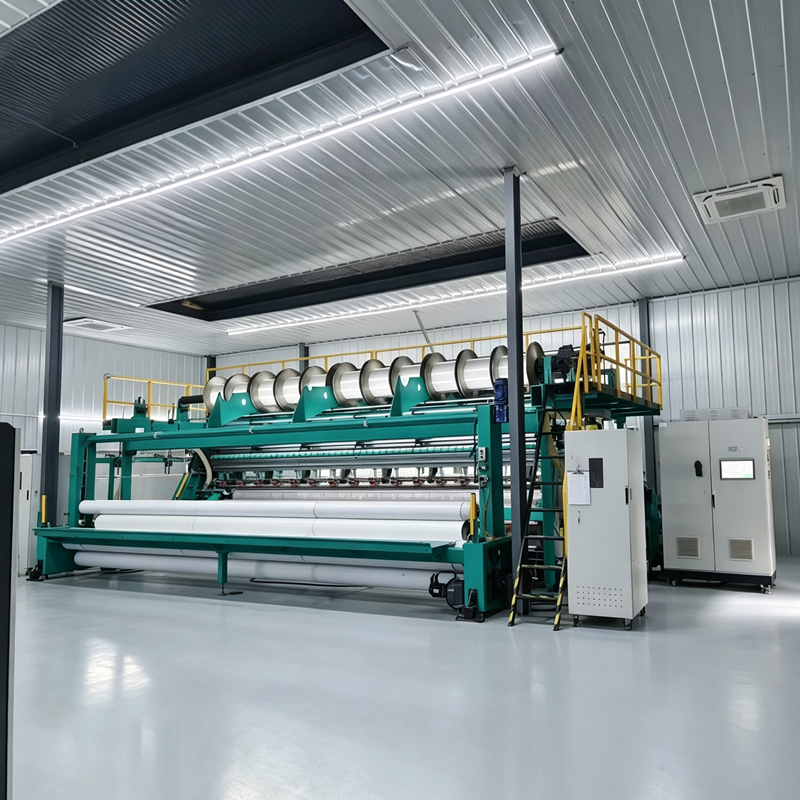
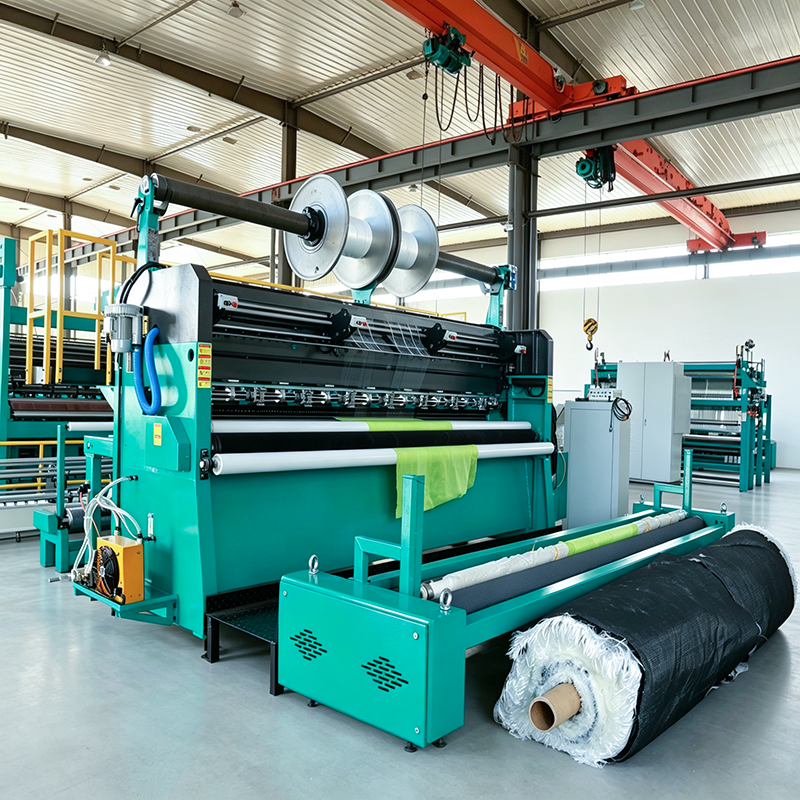 FB Fiber Web Stitch Bonding Machine for Chemical Fiber WebsEntry-level stitch-bonding machine for carded chemical fiber webs, suited to cleaning cloth, interlining, and light geotextile production.View Product →
A fiber web stitch-bonding machine is the standard entry point for converters running carded PET and PP webs at moderate line speeds, and it is usually the correct first machine for a plant that intends to sell into wipes, interlining, and light geotextile simultaneously. Where the plan leans towards higher volumes of lighter web, a high-speed stitch-bonding machine pays back through throughput rather than through capability. The practical difference between them at the sourcing stage is the speed you can hold for a full shift at your actual web weight, not the speed printed on the motor plate. Ask for that number, ask how it was measured, and ask for the fabric weight and bonding yarn count it was measured on.
Before signing, pin down the web weight range the feed section can control without manual intervention, the bonding yarn count range the guide bars and needles tolerate, the doffing arrangement, and whether selvedge trim and edge waste extraction are included. Those four items account for most of the difference between a line that runs unattended and one that needs an operator standing at the feed end all shift.
Biaxial Warp Knitting: When the Fabric Needs Directional Strength
The moment your customer specifies strength in a direction, stitch-bonding stops being the answer. A biaxial warp knitting machine forms a fabric from a warp sheet running in the machine direction at zero degrees and a weft sheet inserted at ninety degrees, bound together by a fine knitting yarn that holds the structure without dominating it. The yarns stay almost straight, which is why the resulting fabric converts tensile strength per gram of material so efficiently — a characteristic that matters enormously in composite reinforcement, roofing membrane, tarpaulin, banner substrate, and geotextile.
The specification that determines everything is the weft insertion system: how many weft yarns per centimetre can be laid, how uniformly they are spaced across the full working width, and how much tension variation exists between the first weft yarn and the last. Weft density ranges commonly quoted span from a light two picks per centimetre up to twelve or more, and fabric weights run from around 80 g/m² to well over 1,000 g/m² depending on yarn linear density. Uniformity, not maximum density, is what separates a good machine from an acceptable one. A weft sheet that sags in the centre or bunches at the selvedge produces fabric that fails a strength test even when the average density is correct.
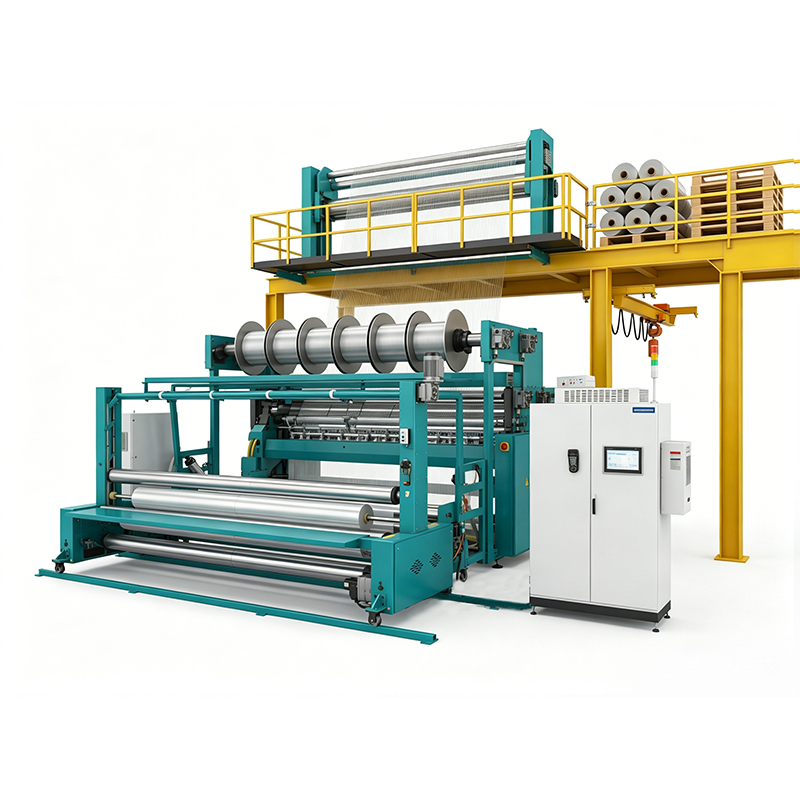
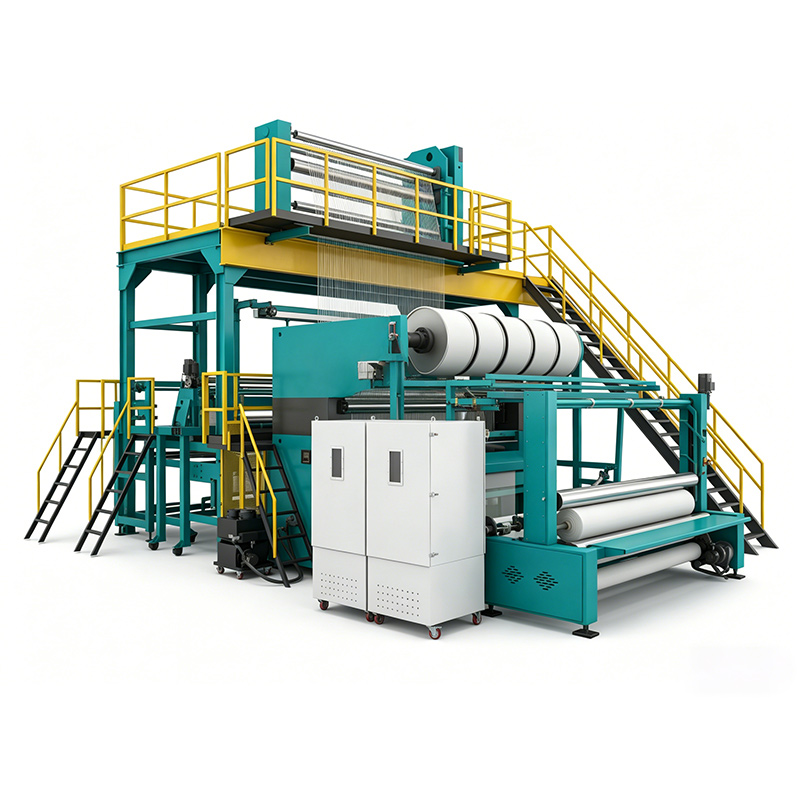
 YXKS2-M Biaxial Warp Knitting Machine for Interlining and CrepeFull-width weft-insertion tricot machine for stable chemical-fiber interlining and crepe fabric, with customizable guide bars and weft density settings.View Product →
A biaxial warp knitting machine is the right platform when the product mix includes reinforcement scrim, banner cloth, and technical fabric where the 0/90 yarn architecture is the value proposition. For banner and advertising fabric specifically, a raschel banner biaxial warp knitting machine is often preferred because the raschel structure and the width capability suit large-format printed substrate, and the surface quality after coating is easier to control. Both belong to the same decision tree, and the deciding question is whether your customers buy mechanical properties or printability.
When you evaluate a biaxial machine, insist on a trial that measures weft density at five points across the width, not one. Ask how the machine compensates for beam diameter reduction from full beam to empty. Ask what happens to weft spacing when line speed changes by twenty percent, because a machine that only holds tolerance at one speed forces you to standardise production around a single product. And ask about weft yarn damage — micro-cracks in inserted filament reduce the finished laminate strength in a way that never shows up in a visual inspection. The broader advantages and application scope of warp knitting production are worth reviewing if you are still deciding between warp knitting and a woven route for a technical fabric.
Terry and Towel Production on Chemical Fiber Yarns
Towels and terry fabrics made from polyester and microfibre are one of the most underrated chemical fiber segments, and they are produced on a machine with a very different mechanical logic from the two families above. In warp-knitted terry, a ground yarn forms the base structure while a pile yarn is drawn into loops that stand away from the surface. Pile height, loop density, and the ratio of pile yarn to ground yarn determine absorbency, hand, and appearance. A well-set terry machine produces uniform loops with no pulled or missing pile, and that uniformity survives dyeing and finishing.
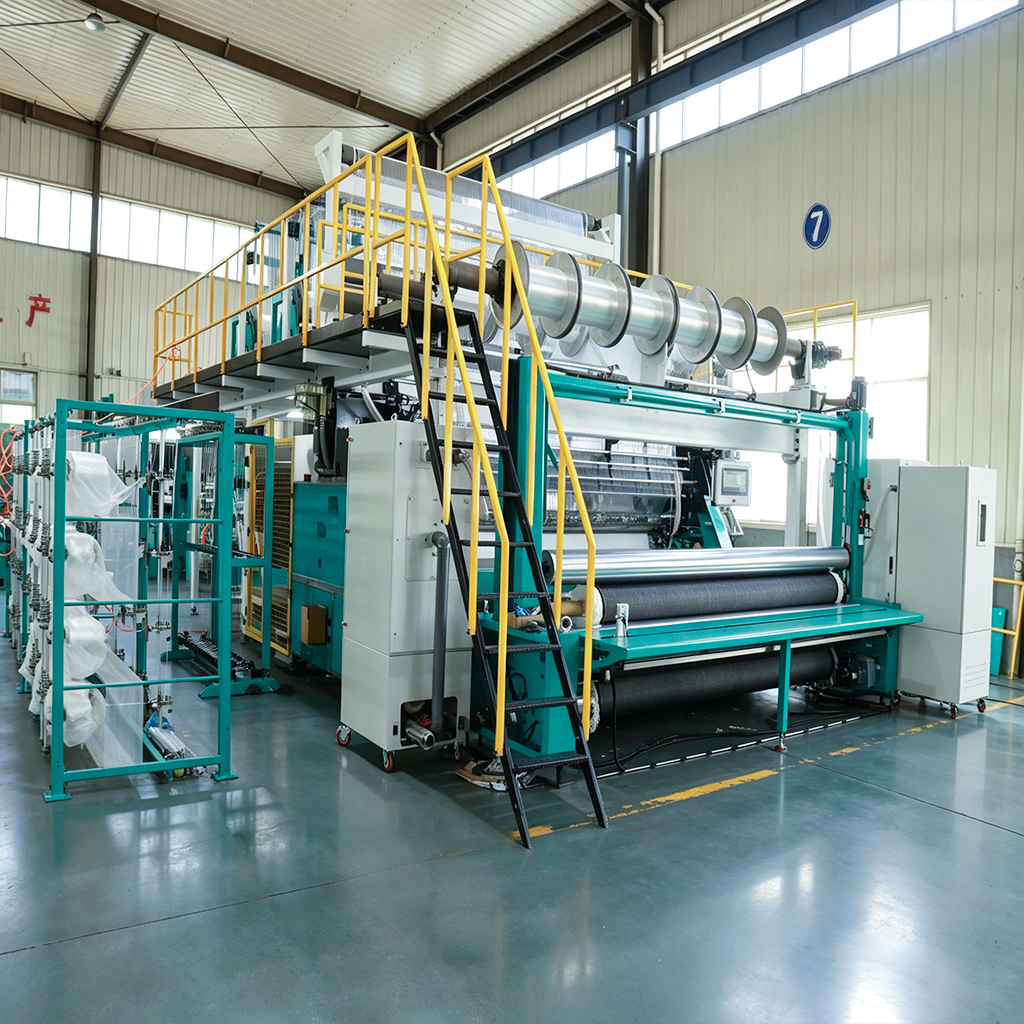
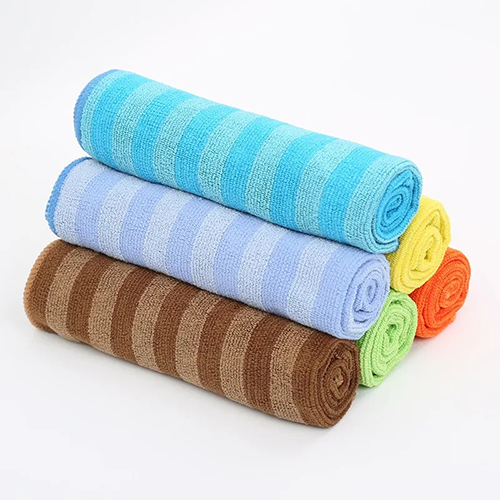 TM Towel Machine for Terry and Loop Pile FabricsTerry warp knitting machine producing single- or double-sided loop pile for cleaning towels, hotel cloths, and EPE foam composites.View Product →
A towel machine built for chemical fiber yarns is configured around the finishing route as much as the knitting action. Polyester and polyamide take disperse dyes at high temperature, and microfibre demands careful heat management to preserve the filament structure that gives the cloth its absorbency. That means the fabric leaving the knitting machine must have consistent loop geometry and consistent width so the stenter and dryer can be set once and left alone. If you produce terry on chemical fiber yarns and the downstream dyer is complaining about dimensional variation, the cause is usually loop formation on the knitting machine, not the finishing line.
Buying considerations here are narrower than for stitch-bonding: pile yarn count range, loop density, working width matched to your finishing equipment, and doffing speed. Because towel production is often run in short campaigns of different styles, changeover time between pile yarn counts deserves the same attention as top speed. A machine that changes over in half an hour and runs at moderate speed usually beats a faster machine that takes half a shift to reset.
Matching Working Width, Gauge, and Configuration to Your Product Mix
Width, gauge, and guide bar count are the three parameters buyers most often treat as fixed, and the three most likely to be over-specified. Table 2 sets out what each one really controls and where over-specification quietly costs money.
| Parameter | What it really controls | Typical range to discuss | Cost of getting it wrong |
|---|---|---|---|
| Working width | Number of saleable metres per hour after edge trim | 2.4 m to 4.6 m for stitch-bonding; wider on request | Wider machine, higher energy per hour, unsold selvedge |
| Gauge (needles per inch) | Fineness of bonding structure and yarn count range | Coarse for heavy web, fine for light cloth | Fine gauge on heavy web breaks needles; coarse gauge limits future products |
| Guide bars | Pattern capability and number of yarn systems | Two bars for standard work, more for structures | Extra bars add capital and setup time with no saleable benefit |
| Beam capacity | Uninterrupted running time and beam change frequency | Sized to your lot sizes | Too small forces frequent stops; too large wastes floor space |
| Rated speed | Ceiling, not output | Always ask for sustainable speed at your fabric | Production planning built on a number the machine cannot hold |
The practical approach is to specify a width that divides cleanly into your customers' finished roll sizes, a gauge that covers the two extremes of your intended range without exceeding them, and the minimum number of guide bars that supports the products you can actually sell within the first two years. Machines are easier to add to than to shrink, but an over-specified machine carries an hourly cost forever.
The Specification Sheet Checklist: Numbers to Get in Writing
Verbal assurances are the most common source of commissioning disputes. Table 3 lists the items worth converting into contractual numbers, together with the verification method that keeps both sides honest.
| Item | What to ask for | How to verify |
|---|---|---|
| Working width | Nominal width and usable width after edge trim | Measure saleable fabric, not frame width |
| Gauge | Needles per inch, with needle type and supplier | Count needles on the needle bar |
| Sustainable speed | Speed held for a full shift at a named fabric specification | Continuous trial run with time and output logged |
| Fabric weight tolerance | Basis weight variation across and along the roll | Cut and weigh samples at defined intervals |
| Weft density uniformity | Picks per centimetre at five points across the width | Measure at five positions on the same sample |
| Tension control | Set point accuracy and drift over a shift | Log tension at start and end of run |
| Yarn count range | Minimum and maximum linear density per system | Trial each extreme, not the middle |
| Power and air consumption | Consumption at production speed, per hour | Meter the supply during the trial |
| Changeover time | Style change duration with a defined crew size | Time a change during commissioning |
| Spare parts list | Wear parts, quantities, and lead time | Confirm against the commissioning stock order |
| Acceptance fabric | Two or three named products passed at full speed | Retain sealed samples signed by both parties |
A supplier confident in the machine will accept these numbers. A supplier who resists putting sustainable speed and weight tolerance into the contract is telling you something useful before you have paid a deposit.
Where Chemical Fiber Projects Actually Go Wrong
Most commissioning failures fall into a small number of repeating patterns. Recognising them at the quotation stage is cheaper than recognising them in month three.
- Planning on mechanical speed. Rated speed is a ceiling measured on a favourable fabric. Real output depends on fiber quality, web uniformity, humidity, and how often the line stops for beam or roll changes. Production plans built on the plate number miss their targets by twenty to thirty percent.
- Ignoring fiber variability. Recycled PET and blended staple vary in crimp, finish, and bulk between deliveries. A machine with narrow tension windows will produce inconsistent fabric when the fiber changes. Wider adjustment range costs a little at purchase and saves a great deal afterwards.
- Under-specifying utilities. Compressed air quality, power stability, and floor-level vibration all affect stitch and weft uniformity. Retrofitting a foundation or a clean air supply after installation is expensive and disruptive.
- Buying for one product. A machine justified by a single order is difficult to adapt when that customer moves. Range of fiber count and stitch density is worth more than a marginal speed advantage.
- Forgotten changeover. In plants running many short campaigns, changeover time dominates the cost model. It is rarely measured at the supplier's factory and almost never guaranteed.
- No agreed acceptance fabric. Without sealed samples and defined tests, "quality" becomes a matter of opinion at the exact moment the final payment is due.
- Neglecting the finishing link. A knitting machine that produces dimensionally unstable fabric pushes cost downstream into the stenter, the dryer, or the dyehouse, where it appears as a complaint rather than a line item.
Each of these can be addressed with a sentence in the technical annex. None of them can be fixed with a discount.
Speed, Efficiency, and Realistic Output Calculations
Output planning should be done by the buyer, on the buyer's fabric, using the buyer's numbers. The arithmetic is simple and worth doing before the quotation is compared.
The base formula is: hourly output in kilograms equals effective line speed in metres per minute, multiplied by 60, multiplied by fabric weight in kilograms per square metre, multiplied by working width in metres. Effective line speed is mechanical speed multiplied by a realistic efficiency factor. For chemical fiber lines, an efficiency of 75 to 88 percent is a reasonable planning band for a well-maintained machine running a stable product, with the lower end applying to web-fed processes and frequent beam changes.
A worked example: a stitch-bonding line running 2.4 m wide fabric at 150 g/m², with a mechanical speed of 24 m/min and an assumed efficiency of 80 percent, gives an effective speed of 19.2 m/min. Hourly output is 19.2 × 60 × 2.4 × 0.15, approximately 415 kg per hour. Run the same calculation at 65 percent efficiency — a realistic figure during the first months after commissioning — and output falls to roughly 337 kg per hour. That difference is often larger than the price gap between two competing machines, which is why efficiency and ramp-up support matter more than a speed figure on a plate.
Two further numbers belong in the model. Downtime cost per hour, calculated from labour, overhead, and lost contribution, tells you how much a reliability improvement is worth. Yarn waste percentage, typically a few percent on a well-set line and considerably more during style changes, tells you the real material cost of a fragmented order book. Both numbers should be applied equally to every machine under consideration, so the comparison is like for like.
Installation, Commissioning, and the First Ninety Days
Commissioning is where the machine either becomes an asset or becomes a topic of daily complaint. The work starts before the machine arrives. The floor must be flat and stable enough to hold alignment, because vibration shows up as stitch irregularity long before it shows up as a mechanical failure. Power should be stable and correctly rated, with protection sized for the drive configuration rather than for a generic motor. Compressed air, if used, needs consistent pressure and dry, filtered supply; moisture in the air line reaches the pneumatic components and then the fabric.
Environmental conditions deserve more attention than they usually get in chemical fiber plants. Temperature and relative humidity affect static, yarn friction, and web handling. A line commissioned in a dry winter will behave differently in a humid summer unless the humidity window is defined and controlled. The supplier should state the assumed conditions in writing, and the plant should be able to hold them.
The first ninety days follow a predictable sequence. Mechanical alignment and levelling. Dry running and safety checks. Trial production on the acceptance fabrics. Optimisation of tension settings and stitch or weft density for each product. Operator training on normal running, on the two or three faults that actually occur, and on changeover. Then a formal review with measured data against the contractual numbers. Plants that treat the trial as a formality, rather than as the moment when every setting is recorded and photographed for future reference, spend the next year rediscovering settings that were correct on day five.
Two practical items make the difference. First, keep a settings log per product, including tension values, speeds, needle type, and yarn batch, so that a repeat order can be set up without an engineer on site. Second, agree in advance who pays for what during ramp-up, including travel and accommodation for support staff, because ambiguous expectations here damage otherwise workable relationships.
Maintenance, Spare Parts, and Consumables
Wear in warp knitting and stitch-bonding machinery concentrates in a small number of components: needles, sinkers, guide needles, and the tension elements that yarn passes over thousands of times per minute. Needle replacement is not an occasional event but a planned consumable cost, and the way it is managed directly determines fabric quality. A needle that has lost its coating produces a stitch that looks acceptable and measures outside tolerance.
Three habits keep a chemical fiber line healthy. First, replace wear parts on a schedule based on running hours and fabric metres, not on failure. Second, clean yarn paths at defined intervals, because spin finish residue accumulates slowly and then suddenly changes friction behaviour. Third, keep a stocked critical spares kit in the plant, sized to cover the lead time from the supplier, and check it at every stocktake. A line stopped for a low-cost component with a six-week lead time is an expensive lesson.
Lubrication deserves the same discipline. Follow the supplier's specified lubricant and interval exactly; substituting a different grade to save money changes friction and heat characteristics in the bearings and can shorten the life of the very components you were trying to protect. Record lubrication, needle changes, and cleaning in the same log as production settings, so that quality deviations can be traced to maintenance events.
Cost Structure: Where the Money Goes Over Five Years
Purchase price typically represents between a quarter and a third of the five-year cost of owning a chemical fiber textile machine. Table 4 shows the main cost lines and the realistic levers available on each.
| Cost line | Relative weight | What drives it | Lever |
|---|---|---|---|
| Machine and installation | High, one-off | Width, gauge, guide bars, automation level | Buy only the capability you can sell |
| Wear parts | Moderate, continuous | Needle quality, fiber abrasiveness, running hours | Planned replacement and good yarn path hygiene |
| Energy | Moderate, continuous | Drive size, width, speed, extraction | Run closer to optimum speed instead of maximum |
| Labour | High, continuous | Number of operators per line, automation | Automatic doffing and beam handling |
| Yarn and web waste | High, variable | Changeover frequency, start-up scrap | Batch orders, faster style changes |
| Downtime | High when it happens | Reliability, spare parts availability, support speed | Critical spares stock, clear support agreement |
Compared side by side, a cheaper machine with a narrower fiber and speed window often costs more per kilogram over five years than a slightly more expensive machine that runs reliably across the product range the plant actually sells. The way to see this is to build the model on kilograms produced rather than on machines purchased, and to apply the same efficiency, waste, and downtime assumptions to every option.
Choosing a Manufacturing Partner, Not Just a Machine
A warp knitting line is a twenty-year relationship with a supplier who may change ownership twice in that period. The questions that matter at selection time are therefore about the company as much as the equipment. Does the supplier manufacture, or does it assemble from purchased sub-units and act as a trading desk? Can it supply the spare parts and the technical support two years from now? Does it have engineering staff who understand fiber behaviour, or only sales staff who understand specifications?
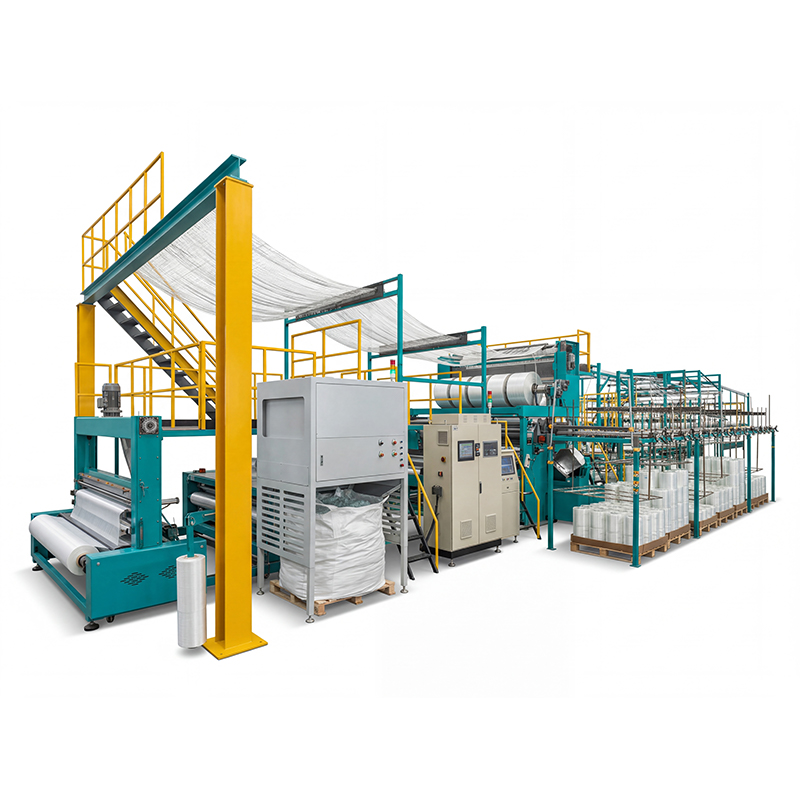
Changzhou Yuanyang Electromechanical Technology Co., Ltd., operating as Danyang Yixun Machinery at yywarpknitting.com, has been building textile machinery since 2008 and describes itself as a high-technology enterprise integrating research, development, manufacturing, sales, and service. Its product range covers three material families — chemical fiber, fiberglass, and carbon fiber — which means the engineering team has had to solve the fiber-specific problems discussed earlier rather than repackage one frame for every application. The chemical fiber range includes stitch-bonding machines, biaxial warp knitting machines, a towel machine, and a raschel banner machine, supported by high-precision warp knitting spare parts and customised special equipment. For buyers who need a supplier able to move between a standard stitch-bonding line and a special configuration without changing vendor, that breadth is a practical advantage. You can review our warp knitting equipment range and the associated spare parts and service offering when preparing a technical comparison.
Practical due diligence should include a visit to a plant running a comparable product, a conversation with that plant's maintenance manager rather than its owner, and a written support commitment covering response time, spare parts availability, and remote assistance. The reference plant should be running your fiber type, not simply your machine class.
Customisation and Special Equipment: When the Standard Model Is Not Enough
Some chemical fiber products simply do not fit a catalogue machine. A converter producing composite carrier fabric may need a nonwoven layer fed and bonded in the same pass as the yarn sheet. A plant running several narrow products may want multiple narrow webs produced across a single wide machine, with slitting downstream. Another may need powder scattering integrated into the line so that the bonding step and the adhesive step happen without an intermediate roll. Others need a special working width to fit an existing tentering frame, or an unusual guide bar arrangement to run a structure their customers specify.
Customisation is worth pursuing when it removes a process step or unlocks a product the standard machine cannot make. It is not worth pursuing when it simply reproduces a competitor's specification or avoids rethinking the product range. Before commissioning a special build, define the acceptance criteria as precisely as for a standard machine, insist on a factory trial of the actual product, and confirm that the custom components are documented in the spare parts list. A custom machine with undocumented internals becomes a support problem the first time a part fails.
Customised spare parts deserve equal attention. High-precision warp knitting components — guide needles, sinkers, and pattern elements — are frequently the difference between a line that holds tolerance and one that drifts. Working with a supplier that manufactures both machinery and precision parts shortens the loop when an unusual component is needed.
Questions to Put in the Inquiry Before You Request a Price
Sending these questions with the inquiry shortens the sales cycle and produces quotations that can actually be compared.
- Which fiber types has this configuration been validated on, and at what linear density range?
- What is the sustainable line speed for a named fabric at a named weight, measured over a full shift?
- What is the basis weight tolerance across and along the roll, and how is it measured?
- What weft density range can be held, and at what uniformity across the working width?
- How many guide bars are included, and what additional structures do extra bars enable?
- What is the style changeover time, with how many operators, for a change of yarn count?
- What are the power, air, and extraction requirements at production speed?
- What environmental conditions must the plant maintain for the stated performance?
- Which components are considered wear parts, what is their expected life, and what do they cost?
- What spare parts are recommended for the first year, and what is their lead time?
- What support is included during installation, commissioning, and the first three months?
- What acceptance tests will be performed, and will sealed samples be retained by both parties?
- What training is provided, for how many operators, and in what language?
- Which reference plants run this exact configuration on our fiber type, and may we contact them?
A supplier who answers all fourteen in writing, with numbers instead of adjectives, has earned the right to be compared on price. A supplier who answers five of them and deflects the rest has told you where the risk will land after the deposit is paid.
The decision sequence for a machine for chemical fiber textile production is short and unforgiving. Identify the fiber you will actually run across the next three years, including the recycled and blended grades your customers are starting to ask for. Identify the fabric architecture your market pays for, whether that is a consolidated web, a directional reinforcement, or a terry surface. Match the machine family to those two answers before anyone opens a price list. Then specify width, gauge, guide bar count, and beam capacity as ranges that cover your realistic product mix, and convert speed, tolerance, consumption, and changeover time into contractual numbers verified by a trial on your own fiber.
Everything after that is execution. Commission with an agreed acceptance fabric, log every setting per product, replace wear parts on schedule, and keep critical spares in the plant. Do those things and a mid-range machine will out-earn a premium machine running in a plant that treats commissioning as paperwork. The equipment matters, but the specification, the trial, and the discipline around consumables are what decide whether the line still looks like a good investment in year five.
News
-
Two quotations land on the same desk. Both offer a multiaxial warp knitting line, both list the same working width, both promise high output. One buyer signs and discovers six months later that the f...
READ MORE -
Which Machine Category Matches Each Technical Fiber and Fabric Goal A warp knitting machine is the primary production platform for technical fiber textiles across fiberglass, chemical fiber, and carbo...
READ MORE -
Have you ever wondered why some weaving looms operate flawlessly for decades, while others seem to suffer from constant breakdowns and quality issues? The secret isn’t luck; it’s a disciplined and str...
READ MORE -
What Is a Tricot Warp Knitting Machine A tricot warp knitting machine is a textile production machine that forms fabric by looping many parallel yarns fed from a warp beam, with each needle working i...
READ MORE
-
Contact Info.
+86-198 5534 1617
+86-134 0158 3002yuanyang@yywarpknitting.com 699#, Shengzhi West Rd, Lvcheng Town, Danyang City, Zhenjiang City, Jiangsu Province, China

-
QR Code
-
Quick Links
Home About Products Manufacturing Customization News Contact -
Product List
Machine for Chemical Fiber Textile Machine for Fiberglass Textile Machine for Carbon Fiber Textile -
About Us
Company Profile Factory Gallery Value-added Service
Copyright © 2026 Changzhou Yuanyang Electromechanical Technology Co., Ltd. All Rights Reserved.
Custom Warp Knitting Machine Manufacturers
