

 English
 中文简体
 русский
 Français
 Español
 Deutsch

What Is a Warp Knitting Machine and How Does It Work in Technical Textile Production?
2026-11-04
Content
- 1 What a Warp Knitting Machine Does
- 2 How a Warp Knitting Machine Forms Fabric, Step by Step
- 3 Main Parts of a Warp Knitting Machine
- 4 Types of Warp Knitting Machines
- 5 Warp Knitting Machines for Fiberglass, Carbon Fiber, and Chemical Fiber
- 6 Warp Knitting vs Weft Knitting
- 7 What Fabrics and Products Are Made on Warp Knitting Machines
- 8 What Affects Warp Knitting Machine Performance
- 9 How to Choose a Warp Knitting Machine
- 10 Frequently Asked Questions
- 10.1 1. What is a warp knitting machine?
- 10.2 2. How does a warp knitting machine work in simple terms?
- 10.3 3. What is a guide bar?
- 10.4 4. What does machine gauge mean?
- 10.5 5. What is the difference between tricot and raschel machines?
- 10.6 6. What is the difference between biaxial and multiaxial machines?
- 10.7 7. Can one warp knitting machine run fiberglass, carbon fiber, and polyester?
- 10.8 8. Is warp knitting better than weaving?
- 10.9 9. How do I estimate the output of a warp knitting machine?
- 10.10 10. What information should I give a supplier before asking for a quotation?
- 11 Conclusion
What a Warp Knitting Machine Does
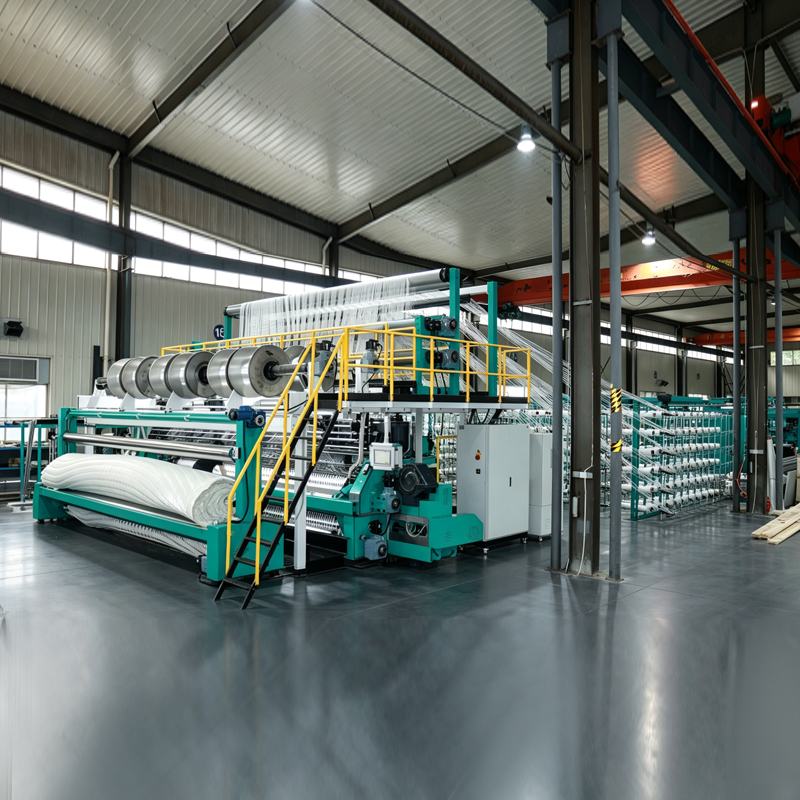
A warp knitting machine turns hundreds or thousands of parallel yarns into a continuous fabric by looping each yarn around a needle and linking it to its neighbours as the guide bars shift sideways. Every needle across the machine has its own yarn, so a full width row of loops is formed in every cycle. That is why warp knitting is the standard way to make mesh, geogrids, non crimp composite reinforcements, tarpaulin base fabrics, and many apparel and household fabrics at industrial scale.
In short, the process runs in six stages:
- Yarns are wound onto warp beams, or fed from a creel.
- A let off system releases the yarn at a controlled rate and tension.
- Guide bars place each yarn around its needle.
- The needles pull new loops through the old ones.
- Guide bars shift sideways to link neighbouring loops and set the pattern.
- A take down system draws the finished fabric away and winds it into rolls.
Machines are grouped mainly into tricot and raschel types, with double needle bar, jacquard, biaxial, and multiaxial versions for special structures. The right choice depends on the fabric you need to make, the fiber you plan to run, and the output you must reach.
How a Warp Knitting Machine Forms Fabric, Step by Step
Step 1: Yarn Supply From Beams or a Creel
Yarn reaches the knitting zone from warp beams, which are large flanged spools carrying many parallel ends, or from a creel of individual packages. A beam is prepared on a warping machine so that every end is wound side by side at the same tension. The number of ends is large. At a gauge of E24, which means 24 needles per inch, a machine with a working width of 4.5 metres carries about 4,250 needles, and a single fully threaded guide bar can control that many yarn ends.
Because the ends run side by side, small differences in yarn count, tension, or friction show up as visible lines in the finished cloth. Yarn quality and careful beam preparation therefore matter as much as the machine itself.
Step 2: Let Off Keeps Tension Steady
The let off system releases yarn from each beam in step with the knitting cycle. Fabric structure depends on how much yarn is fed per row of loops, called the runner length. Modern machines use electronic or servo controlled let off drives that measure the demand and adjust beam speed continuously, so tension stays steady even as the beam diameter shrinks. For stiff, brittle, or slippery fibers, steady low tension is essential.
Step 3: Guide Bars Place the Yarn
Each guide bar carries a row of guides, and every guide threads one yarn. The bar makes two kinds of movement in each cycle:
- Overlap: the bar swings the yarn around the needle, over its top, so the needle can catch it.
- Underlap: after the overlap, the bar shifts sideways, called shogging, by one or more needle spaces. The yarn laid across the back of the fabric joins the loop to its neighbours.
Most machines have two or more guide bars. More bars give more freedom to combine ground structures, pattern yarns, and inlay yarns in a single fabric.
Step 4: Needles Form the Loops
The needles sit in a bar across the full width and move up and down together. In simple terms, the needle rises so that the old loop slides down its stem, the guide bar lays new yarn over the needle, and the needle then descends, drawing the new yarn through the old loop. The old loop is cast off and the new one becomes part of the fabric. Tricot machines usually use compound needles, which close with a sliding element, while raschel machines typically use latch needles, which close with a small hinged latch. Both can be fitted with auxiliary parts such as sinkers or knocking over bars that hold the fabric down while the needles move.
Step 5: The Lapping Pattern Decides the Structure
The sequence of overlaps and underlaps is called the lapping pattern. A small change in the pattern gives a very different fabric. Four basic lappings explain most of what the machine can do:
| Lapping | Guide Bar Movement | Result | Typical Use |
|---|---|---|---|
| Chain (pillar) stitch | Overlap on the same needle, no sideways underlap | Vertical columns of loops, strong in the length direction | Binding and holding inlay yarns in place |
| Tricot lapping | Underlap of one needle space | Smooth, closed, zigzag structure | Fine apparel and lining fabrics, ground structure |
| Atlas lapping | Underlap of several needle spaces in steps | Diagonal effects, more extensible structure | Patterned and elastic fabrics |
| Weft inlay | Yarn laid across the width and trapped by stitches | Straight cross yarns with high dimensional stability | Mesh, geogrids, reinforcement fabrics |
Step 6: Take Down and Batching
The take down system draws the finished fabric away from the needles at a measured speed and winds it into a roll. The take down speed sets the number of courses per centimetre, which controls fabric density, weight, and dimensions. If the take down drifts out of step with the knitting cycle, the fabric changes weight and appearance along its length, so modern machines synchronise it electronically with the main drive.
The speed of the machine is quoted in courses per minute, and a course is one full width row of loops. A rough output check is simple. At 800 courses per minute and 8 courses per centimetre, the fabric advances 100 centimetres, or 1 metre, every minute, which is 60 metres an hour. On a 4.5 metre machine that is about 270 square metres an hour in theory, or around 230 square metres an hour at 85 percent running efficiency. These figures are illustrative, but the same calculation lets you compare machines and quotations on an equal basis.
Main Parts of a Warp Knitting Machine
A warp knitting machine is a set of tightly synchronised systems. Knowing what each system does makes it easier to read a specification sheet and to see where a problem comes from when the fabric shows a defect.
| Part | What It Does | What to Check |
|---|---|---|
| Warp beams and creel | Hold and supply the yarn ends | Beam capacity, number of beams, creel layout |
| Let off system | Releases yarn at a controlled rate and tension | Electronic control, tension accuracy |
| Guide bars | Place yarn around needles and shog sideways | Number of bars, guide material, shogging range |
| Needle bar and needles | Form the loops | Gauge, needle type, single or double bar |
| Sinkers or knocking over bars | Support the fabric during loop formation | Wear, alignment, material |
| Patterning system | Controls guide bar movement | Mechanical or electronic, ease of changing patterns |
| Weft insertion unit | Lays yarn layers across or at angles (biaxial and multiaxial machines) | Number of layers, angles, insertion speed |
| Take down and batching | Draws and winds the fabric | Speed control, roll size, tension on the fabric |
| Drive and control system | Synchronises all movements | Servo drives, sensors, monitoring, data logging |
Types of Warp Knitting Machines
Tricot Machines
Tricot machines are built for speed and fine structures. They have a single needle bar, compound needles, and relatively few guide bars, and they commonly run at over 1,000 courses per minute on fine yarns. Their typical output is smooth, closed fabric for lingerie, sportswear, linings, and automotive textiles.
Raschel Machines
Raschel machines use latch needles and can carry more guide bars, which makes them the more flexible family. They handle a wider range of yarn types and counts, from fine filament to heavy technical yarn, and they can form open, patterned, or bulky structures such as mesh, lace, curtains, nets, and reinforcement fabrics. Running speeds are usually lower than on tricot machines, because the structures are heavier and more complex.
| Feature | Tricot Machine | Raschel Machine |
|---|---|---|
| Needle type | Usually compound needles | Usually latch needles |
| Guide bars | Fewer, often two to four | Many more, up to dozens on some models |
| Speed | Higher | Lower, depending on structure |
| Fabric | Smooth and closed | Open, patterned, or bulky |
| Yarn range | Mostly fine filament | Fine to heavy technical yarns |
| Typical products | Lingerie, sportswear, linings | Mesh, geogrids, lace, reinforcement fabrics |
Double Needle Bar Machines
A double needle bar machine has two needle beds facing each other. Two fabric layers can be knitted at once and joined by connecting yarn, which gives spacer fabrics, three dimensional mesh, and plush structures. They are used where thickness, cushioning, and airflow are required.
Jacquard Machines
Jacquard machines add individual control over selected guides, so yarns can be placed one by one rather than in rows. This opens up detailed patterns, decorative fabrics, and structured surfaces that ordinary bar controlled machines cannot produce.
Biaxial and Multiaxial Machines
Biaxial and multiaxial machines combine warp knitting with a weft insertion unit. Layers of straight, parallel yarn are laid at 0 and 90 degrees, and on multiaxial machines also at plus and minus 45 degrees or other angles. A fine stitching yarn, usually in chain or tricot lapping, then binds the layers through the thickness. Because the load carrying yarns stay straight instead of weaving over and under each other, the result is called a non crimp fabric, and it makes efficient use of the fiber's strength. This is the key technology behind reinforcement fabrics for composites, geogrids, and many industrial products.
Warp Knitting Machines for Fiberglass, Carbon Fiber, and Chemical Fiber
The same basic principle applies to every fiber, but the machine must be configured for the fiber it will run. Choosing a machine without matching it to the fiber is one of the most common and most expensive mistakes.
- Fiberglass: glass filaments are strong but brittle and highly abrasive. Machines for fiberglass textile use smooth, hard wearing guides, gentle yarn paths, and low, steady tension. Typical products include fiberglass mesh, geogrids, and biaxial or multiaxial reinforcement for composites.
- Carbon fiber: carbon tows are very strong along their length but break easily if bent sharply or rubbed. Machines for carbon fiber textile need very low tension, careful handling of flat tows, and stitching that does not distort the straight fibers. Typical products are multiaxial fabrics for lightweight structural parts.
- Chemical fiber: polyester, nylon, polypropylene, and other man made fibers cover a very wide range of products, from truck tarpaulin base fabrics and clothing interlining to towel and terry cloth structures and nonwoven combined fabrics. Machines for chemical fiber textile are set up for the specific yarn type, structure, and running speed.
In practice, a machine built for one of these fiber families is usually not the right tool for another without changes to guides, tension systems, and drives. Describe your fiber and fabric to the supplier before you talk about price.
Warp Knitting vs Weft Knitting
Both methods make fabric from loops, but the way yarn is fed and the way the loops connect are different.
| Feature | Warp Knitting | Weft Knitting |
|---|---|---|
| Yarn direction | Along the fabric length, one yarn per needle | Across the fabric width, one yarn feeds many needles |
| Loop connection | Loops link with neighbours through guide bar shogging | Loops link along a single course |
| Unravelling | Resists running and unravelling | Can unravel if a loop breaks |
| Stability | Generally more stable, can include straight inlay yarns | Generally more stretchy |
| Fabric width | Flat fabric, often very wide | Flat or tubular fabric |
| Typical products | Mesh, lace, geogrids, composites, technical fabrics | T shirts, sweaters, socks, jersey |
The key practical point is the ability to include straight inlay yarns. Weft knitting cannot easily do this, while warp knitting can lock them in place, which is what makes it so useful for reinforcement and technical products.
What Fabrics and Products Are Made on Warp Knitting Machines
- Construction and geotechnical: fiberglass mesh, geogrids, and reinforcement fabrics for walls, roads, and slopes.
- Composites and new energy: biaxial and multiaxial reinforcement for wind blades, vehicle parts, and lightweight structural panels.
- Transport and logistics: truck tarpaulin base fabric and other coated fabrics.
- Automotive: interior textiles and technical fabrics for vehicle components.
- Apparel and home textiles: clothing interlining, lining fabrics, towels, and terry cloth.
- Mining and industrial: heavy duty and high strength fabrics for demanding environments.
What Affects Warp Knitting Machine Performance
A high advertised speed does not guarantee good output. Fabric quality and real production depend on several linked factors.
- Yarn quality: uniform count, strength, and surface friction reduce yarn breaks and lines in the fabric.
- Tension control: even tension across all ends keeps loops uniform. Weak control causes streaks and holes.
- Gauge: needle spacing sets how fine the fabric can be and which yarn counts the machine can run.
- Guide bar setup: the number and arrangement of bars limit the structures that can be made.
- Speed settings: running faster only helps if stability, tension, and fabric quality are maintained.
- Take down accuracy: precise synchronisation keeps weight and dimensions constant along the roll.
- Maintenance: worn needles, guides, and bearings cause defects and stoppages, so a regular inspection and replacement schedule is part of good production.
How to Choose a Warp Knitting Machine
Start with the product, then work back to the machine. The following sequence keeps the decision practical.
- Define the fabric: weight per square metre, structure, thickness, and any required angles or layers.
- Define the fiber: glass, carbon, polyester, nylon, polypropylene, or a combination, with yarn count and form such as roving, tow, or filament.
- Set the working width: match it to your finished product and cutting plan, since width drives both cost and output.
- Select the machine type: raschel, biaxial, multiaxial, double needle bar, or another configuration, based on the structure.
- Confirm gauge and guide bars: they must support your yarn count and pattern.
- Estimate real output: use the calculation shown earlier with a realistic efficiency, not the maximum speed.
- Check controls and automation: electronic let off, take down, and monitoring reduce operator dependence.
- Review support: installation, commissioning, operator training, spare parts, and after sales response time.
When you contact a supplier, send a fabric sample or a clear drawing, the yarn details, the target width, the required monthly output, and your local power supply. With that information, a supplier can recommend a configuration instead of quoting a generic model. Ask for a factory test run on your own yarn if possible, because it shows how the machine behaves with your material before it ships.
Frequently Asked Questions
1. What is a warp knitting machine?
It is an industrial machine that makes fabric by looping many parallel yarns around needles and linking the loops with guide bar movements, producing a continuous flat fabric at high speed.
2. How does a warp knitting machine work in simple terms?
Yarn is fed from beams, guide bars lay it around the needles, the needles pull new loops through the old ones, the guide bars shift sideways to connect the loops, and a take down system winds up the fabric.
3. What is a guide bar?
A guide bar is a bar carrying a row of yarn guides. It swings yarns around the needles and shifts sideways, and these movements decide how loops connect and what pattern the fabric has.
4. What does machine gauge mean?
Gauge describes needle density, usually as needles per inch. For example, E24 means 24 needles per inch, about 9.4 per centimetre. Higher gauge numbers give finer fabric and need finer yarn.
5. What is the difference between tricot and raschel machines?
Tricot machines are faster and suited to fine, smooth fabrics, while raschel machines are more flexible, carry more guide bars, and are used for open, patterned, and technical structures. Real capabilities depend on the specific model.
6. What is the difference between biaxial and multiaxial machines?
A biaxial machine lays yarn layers at two directions, usually 0 and 90 degrees, while a multiaxial machine adds layers at other angles such as plus and minus 45 degrees. Both bind the layers with a knitted stitching yarn to make non crimp fabric.
7. Can one warp knitting machine run fiberglass, carbon fiber, and polyester?
Not without changes. Each fiber needs suitable guides, tension control, and drive settings, so machines are normally configured for a fiber family. Tell your supplier which fibers you plan to run.
8. Is warp knitting better than weaving?
It depends on the product. Warp knitting forms loops and can place straight yarns without crimp, which suits reinforcement and mesh, and it can cover very wide widths. Weaving interlaces yarns and suits fabrics that need a tight, flat construction. The right choice depends on strength, structure, and cost.
9. How do I estimate the output of a warp knitting machine?
Divide the speed in courses per minute by the courses per centimetre to get the fabric length per minute, then multiply by the working width and by a realistic running efficiency. Use the same method to compare different machines and quotations.
10. What information should I give a supplier before asking for a quotation?
Provide a fabric sample or drawing, fabric weight, fiber and yarn count, target width, expected monthly output, local power supply, and your plans for automation. This lets the supplier recommend the correct configuration.
Conclusion
A warp knitting machine works by coordinating yarn supply, guide bar movement, needle action, and fabric take down so that parallel yarns become a continuous, stable fabric. Tricot machines favour speed and fine fabrics, raschel machines favour flexibility, and biaxial and multiaxial machines add straight reinforcing layers for composites and geogrids. The right choice always starts with the fabric, the fiber, and the output you need.
Yuanyang Electromechanical designs and builds warp knitting machinery for specialty textile applications. Explore the machine ranges for chemical fiber textile, fiberglass textile, and carbon fiber textile, or send your fabric requirements to discuss a customized configuration.
News
-
Warp Knitting Machines: Machine Architecture, Yarn Control and Industrial Fabric Output Inside a warp knitting machine, every single yarn has its own itinerary. A thousand or more ends leave their be...
READ MORE -
What Is a Tricot Warp Knitting Machine A tricot warp knitting machine is a textile production machine that forms fabric by looping many parallel yarns fed from a warp beam, with each needle working i...
READ MORE -
What a Stitch Bonding Machine Does A stitch bonding machine is a warp knitting type machine that uses knitting needles and a stitching yarn to hold a web of fibers, a layer of chopped strands, or a la...
READ MORE -
Three quotations land on the same desk for the same polyester nonwoven line, and on paper they look interchangeable. Each is priced per metre of working width. Each quotes a similar top speed. Each c...
READ MORE
-
Contact Info.
+86-198 5534 1617
+86-134 0158 3002yuanyang@yywarpknitting.com 699#, Shengzhi West Rd, Lvcheng Town, Danyang City, Zhenjiang City, Jiangsu Province, China

-
QR Code
-
Quick Links
Home About Products Manufacturing Customization News Contact -
Product List
Machine for Chemical Fiber Textile Machine for Fiberglass Textile Machine for Carbon Fiber Textile -
About Us
Company Profile Factory Gallery Value-added Service
Copyright © 2026 Changzhou Yuanyang Electromechanical Technology Co., Ltd. All Rights Reserved.
Custom Warp Knitting Machine Manufacturers
