

 English
 中文简体
 русский
 Français
 Español
 Deutsch

Choosing a Warp Knitting Machine for Chemical Fiber Fabrics
2026-11-10
Content
- 1 How a Warp Knitting Machine Works With Chemical Fibers
- 2 Chemical Fibers and How They Behave on the Machine
- 3 Warp Knitting Machine Types for Chemical Fiber Textile
- 4 Key Specifications and What They Mean
- 5 Fabric Weight and Output: A Worked Example
- 6 Products Made on a Warp Knitting Machine for Chemical Fiber Textile
- 7 Yarn Preparation and Workshop Conditions
- 8 Common Fabric Defects and Fixes
- 9 How to Choose a Warp Knitting Machine for Chemical Fiber Textile
- 10 Operation and Maintenance Tips
- 11 Where to Find a Machine
- 12 Frequently Asked Questions
- 12.1 1. What is a Warp Knitting Machine?
- 12.2 2. What is a Warp Knitting Machine for Chemical Fiber Textile?
- 12.3 3. What is the difference between tricot and raschel machines?
- 12.4 4. What gauge should I choose?
- 12.5 5. How do I estimate the output of a Warp Knitting Machine?
- 12.6 6. Which fibers can run on a chemical fiber warp knitting machine?
- 12.7 7. How do I control static when knitting polyester?
- 12.8 8. What products suit a weft insertion machine?
- 12.9 9. What causes streaks and lines in warp knitted fabric?
- 12.10 10. What should I send a supplier to get a quotation?
Match the machine type to the fabric: choose a tricot Warp Knitting Machine for fine, smooth fabrics such as lining and sportswear, a raschel machine for open, patterned, and technical fabrics, a double needle bar machine for spacer fabrics, and a weft insertion machine for strong base fabrics such as tarpaulin and geogrid. Then match the gauge to the yarn, the width to your product, and the guide bar count to the structure. A Warp Knitting Machine for Chemical Fiber Textile is built for man made yarns such as polyester, nylon, and polypropylene, so it needs steady low tension, good let off control, and control of static and heat.
As a rough guide, fine filament yarns of about 20 to 150 denier suit gauges from E28 to E44 on a tricot machine, and heavier or more textured yarns suit coarser gauges from E12 to E24 on a raschel machine. A modern high speed tricot machine can run at well over 1,000 courses per minute, while heavier raschel and weft insertion machines run more slowly. Output depends on speed, stitch density, and width, and a worked example later in this guide shows how to estimate it. The sections below explain how chemical fibers behave on the machine, compare machine types, define the key specifications, show output and fabric weight calculations, list common products and defects, and give a step by step selection method.
How a Warp Knitting Machine Works With Chemical Fibers
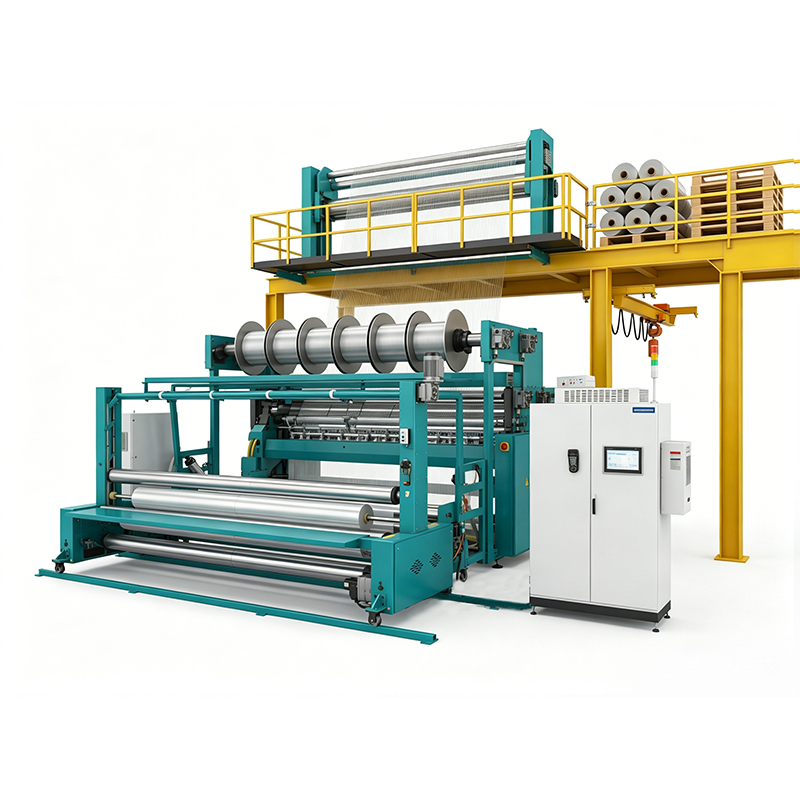
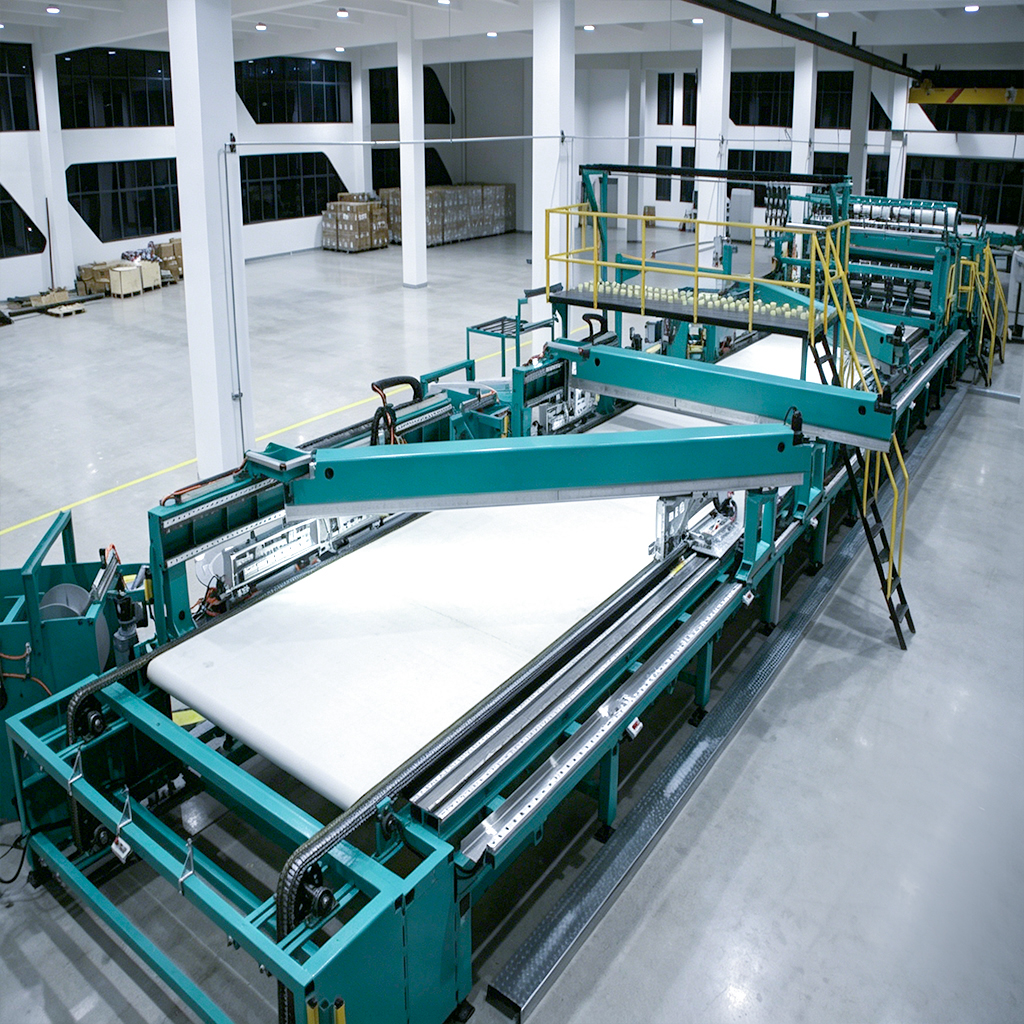
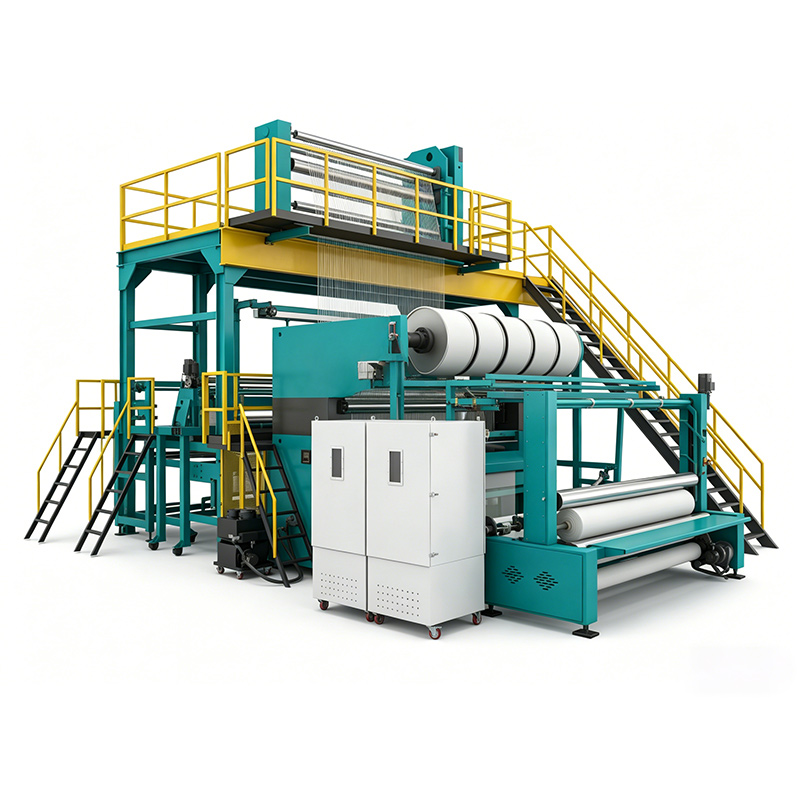
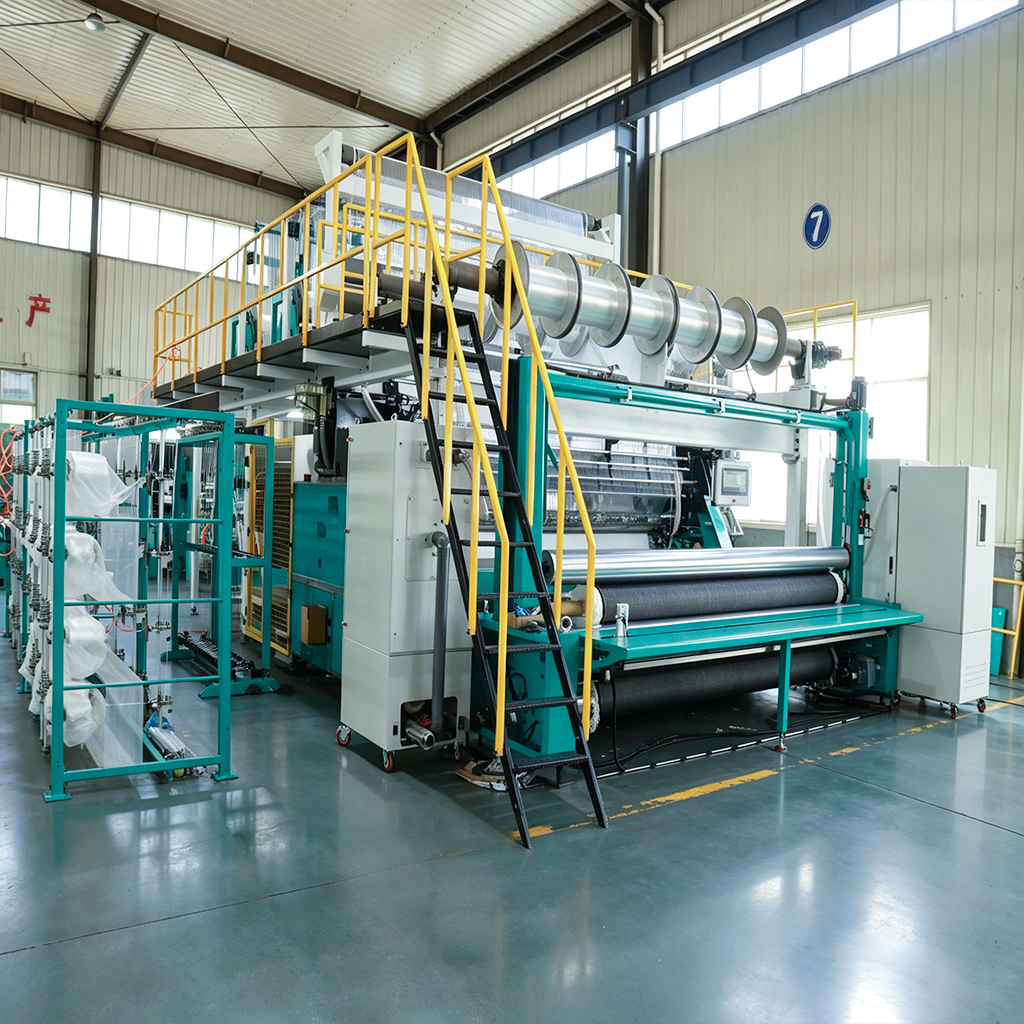
A Warp Knitting Machine forms fabric by looping parallel warp yarns around needles and linking the loops with sideways movements of guide bars. Yarn comes from warp beams, passes through a let off system, and is placed around the needles by the guide bars. The needles pull new loops through old ones, and a take up system draws the finished fabric away and winds it into rolls. Every needle has its own yarn, so a full width row of loops, called a course, forms in each cycle.
Chemical fibers suit this process well because they are continuous filaments with uniform diameter, high strength, and low hairiness. That means few breaks and little lint, which helps at high speed. The same properties also create demands. Man made filaments have smooth surfaces and can generate static electricity, they are sensitive to tension changes, and they need controlled heat setting after knitting. A machine for chemical fibers must therefore hold tension steady across thousands of ends, remove or control static, and run in a stable workshop climate.
Chemical Fibers and How They Behave on the Machine
| Fiber | Key Behavior on the Machine | Typical Heat Setting After Knitting | Typical Products |
|---|---|---|---|
| Polyester (PET) | Strong, low moisture uptake, builds static, needs antistatic oil and humidity control | About 180 to 210 degrees Celsius | Sportswear, linings, tarpaulin base, geotextile, curtains |
| Nylon (PA6 and PA66) | Elastic, absorbs some moisture, sensitive to tension variation | About 170 to 200 degrees Celsius | Lingerie, swimwear, power mesh, airbag and technical fabrics |
| Polypropylene (PP) | Very low moisture uptake, low friction, low melting point | Low, about 120 to 140 degrees Celsius | Nets, geotextile, agricultural fabrics |
| Aramid | Very strong, low stretch, sensitive to light and sharp edges | Usually no heat setting | Protective fabrics, reinforcement |
| High performance polyethylene | Slippery, very strong, needs grip and low speed | Low or none | Cut resistant and protective fabrics |
| Elastane with nylon or polyester | Stretchy, needs positive feed and precise tension | Set carefully to keep stretch | Shapewear, medical and sports textiles |
Static is a real issue with polyester, because its moisture uptake is only about 0.4 percent. Spin finish, antistatic ionizers, and workshop humidity of around 55 to 65 percent are common ways to control it. Nylon takes up more moisture, around 4 percent, so it generates less static but changes dimension with humidity, which affects tension and fabric width.
Warp Knitting Machine Types for Chemical Fiber Textile
| Machine Type | Typical Gauge | Typical Speed | Typical Width | Main Products |
|---|---|---|---|---|
| Tricot | E28 to E44 | 1,500 to 3,500 courses per minute | About 3.3 to 6.6 m | Lingerie, linings, sportswear, automotive interiors |
| Raschel | E12 to E32 | 500 to 1,800 courses per minute | About 2 to 5.4 m | Mesh, lace, curtains, nets, technical fabrics |
| Double needle bar raschel | E12 to E24 | 300 to 800 courses per minute | About 2 to 4 m | Spacer fabrics, three dimensional mesh, plush |
| Jacquard raschel | E18 to E32 | 400 to 1,200 courses per minute | About 2 to 4 m | Lace, decorative fabrics, curtains |
| Weft insertion machine | E5 to E14 | 200 to 800 courses per minute | About 2 to 6 m | Tarpaulin base fabric, geogrid, reinforcement |
These ranges are typical, not limits, and each model has its own specification. Use them to shortlist machine types, then check the data sheet of the exact model.
Key Specifications and What They Mean
Gauge
Gauge is the number of needles per inch, written with the letter E. E32 means 32 needles per inch, about 12.6 per centimeter. A finer gauge makes a denser, smoother fabric and needs a finer yarn. As a general rule, the yarn must be thin enough to pass freely through the spaces between needles, so a fine gauge such as E40 suits yarns of about 20 to 70 denier, and a coarse gauge such as E14 suits much heavier yarns.
Number of Guide Bars
Guide bars place the yarn, and each bar adds possibilities. Two bars make the basic structures. Four to eight bars allow lace, nets, and multi layer patterns, and a weft insertion unit adds straight yarns across the fabric. More bars mean more beams, more creel space, and more cost.
Working Width
Wide machines make more fabric per hour, but they need more yarn, a larger creel, and bigger beams. Choose the width to suit your product and your cutting plan. For example, a 3.4 meter machine at E30 carries about 4,000 needles, and each needle needs its own end of yarn.
Speed
Speed is given in courses per minute or machine revolutions per minute. The maximum is not the working speed, which is usually lower and depends on the yarn, the structure, and the target quality. A realistic efficiency of 80 to 90 percent is a good basis for planning.
Let Off and Take Up
Electronic let off drives feed each beam at the rate the pattern needs, keeping tension steady as the beam diameter shrinks. An electronic take up keeps the fabric density, measured in courses per centimeter, constant. These two systems matter most for stretch fabrics with elastane and for fine nylon, where small tension changes show up as streaks.
Patterning System
Guide bar patterns can be set by chains and cams or by electronic drives. Electronic systems change patterns quickly and store designs, which helps when you make many small orders.
Fabric Weight and Output: A Worked Example
You can estimate fabric weight from the stitch density, the yarn length per stitch, and the yarn count. The formula is: weight in grams per square meter equals the number of stitches per square meter, times the yarn length per stitch in meters, times the yarn count in tex divided by 1,000.
As an illustration, take a single bar construction at E30, which is about 11.8 wales per centimeter, with 12 courses per centimeter. That is about 11.8 times 12 times 10,000, or 1.42 million stitches per square meter. If each stitch uses 3 millimeters of yarn, that is 4,250 meters of yarn per square meter. With a 78 dtex yarn, which is 7.8 tex, the weight is 4,250 times 7.8 divided by 1,000, or about 33 grams per square meter. A fabric with several bars is heavier, since each bar adds yarn.
Now estimate output. At 2,000 courses per minute and 12 courses per centimeter, the fabric advances 2,000 divided by 12, or about 167 centimeters a minute, which is 1.67 meters a minute or 100 meters an hour. On a 3.4 meter machine, that is 340 square meters an hour in theory. At 85 percent efficiency, it is about 289 square meters an hour, or about 9.5 kilograms an hour at 33 grams per square meter. These figures are illustrations, but the method works for any machine and lets you compare quotations fairly.
Products Made on a Warp Knitting Machine for Chemical Fiber Textile
- Lingerie and shapewear: fine nylon and elastane on tricot and raschel machines, including power mesh and lace.
- Sportswear and linings: polyester and nylon mesh and smooth fabrics on tricot machines, valued for breathability and stretch.
- Tarpaulin base fabric: high tenacity polyester, often around 1,000 denier, laid as straight yarns on a weft insertion machine, then coated with PVC for truck covers, tents, and banners.
- Geotextiles and geogrids: polyester and polypropylene fabrics used in road building and slope protection, valued for tensile strength and dimensional stability.
- Spacer fabrics: two fabric layers joined by monofilament yarn, made on double needle bar machines, used in mattresses, shoes, seats, and sports protection.
- Curtains and home textiles: jacquard raschel lace and mesh in polyester.
- Automotive fabrics: seat covers, headliners, and interior trims knitted on tricot machines and often laminated.
- Nets and agricultural fabrics: shade nets, insect nets, and packing nets on raschel and crochet machines.
- Industrial and protective fabrics: filtration, medical, and protective textiles in aramid and high performance fibers.
Yarn Preparation and Workshop Conditions
- Beam preparation: beams must be wound with even tension, correct end count, and no crossed ends. Poor beams cause lines in the fabric that no machine can fix.
- Yarn quality: uniform denier, low knots, and consistent spin finish reduce breaks and streaks. Keep batches separate and label them.
- Climate control: a stable temperature of about 20 to 26 degrees Celsius and relative humidity of about 55 to 65 percent are common targets for synthetic knitting rooms.
- Static control: use antistatic oil, ionizing bars, and grounded guides, particularly with polyester.
- Cleanliness: lint, oil, and dust on guides and needles cause defects, so schedule regular cleaning.
- Heat setting: set the fabric after knitting at the right temperature and time for the fiber, to fix dimensions and handle.
Common Fabric Defects and Fixes
| Defect | Likely Cause | Typical Fix |
|---|---|---|
| Lengthwise streaks | Uneven yarn tension, mixed yarn lots, bent needle | Check beam preparation, yarn batches, and needles |
| Crosswise lines or bars | Let off or take up variation, beam change | Check the drives and set the timing |
| Holes | Yarn breaks, knots, damaged needle | Fix the break cause, replace needles, check guides |
| Runs or laddering | Missing yarn at a needle, worn guide | Replace worn guides, check threading |
| Curling or width variation | Tension imbalance, heat setting differences | Adjust tension and heat setting |
| Static lint or yarn clinging | Dry air, high static, poor finish | Raise humidity, use ionizers, check the yarn finish |
| Uneven fabric weight | Unsteady take up or runner length drift | Recalibrate the take up and let off |
How to Choose a Warp Knitting Machine for Chemical Fiber Textile
- Define the fabric. Fabric type, weight, structure, width, and handle, and any stretch or strength needs.
- Define the yarn. Fiber, denier, filament count, and form, such as flat, textured, or monofilament.
- Select the machine type. Tricot, raschel, double needle bar, jacquard, or weft insertion, based on the structure.
- Match gauge and guide bars. The gauge must suit the yarn, and the bar count must suit the pattern.
- Choose width and creel. Allow for the beams, creel space, and the plant layout.
- Plan the real output. Use the output method above with a realistic efficiency, not maximum speed.
- Check the controls. Electronic let off, take up, patterning, and monitoring reduce operator dependence and speed changeover.
- Review build quality and support. Frame rigidity, bearings, spare parts, installation, operator training, and response time for service.
- Ask for a sample run. A test with your own yarn shows real speed, tension, and fabric quality.
When you ask for a quotation, send a fabric sample or drawing, yarn details, target width, monthly output, local power supply, and your plans for automation. This lets a supplier recommend a configuration instead of a generic model.
Operation and Maintenance Tips
- Inspect needles, guides, and sinkers on a schedule, and replace worn parts before they cause defects.
- Clean lint and oil from the knitting zone every shift, and keep the creel area tidy.
- Lubricate according to the manual, and keep the oil system clean.
- Check the let off and take up drives and calibrate them regularly.
- Keep spare needles, guides, and a few key parts on site to cut downtime.
- Record settings for each style, so you can repeat good runs.
- Train operators in threading, tension checks, and basic fault finding.
Where to Find a Machine
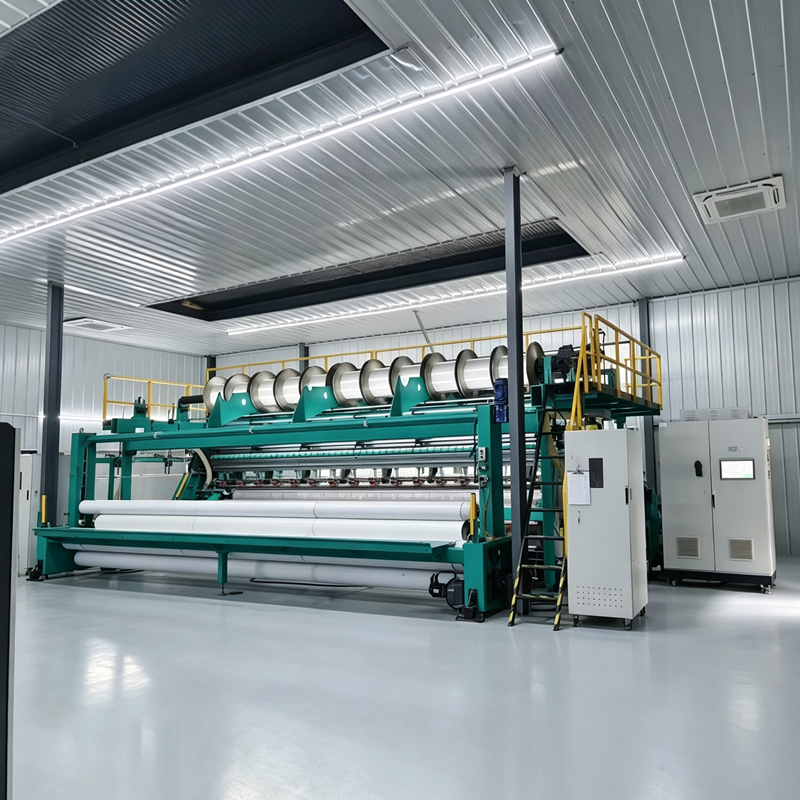
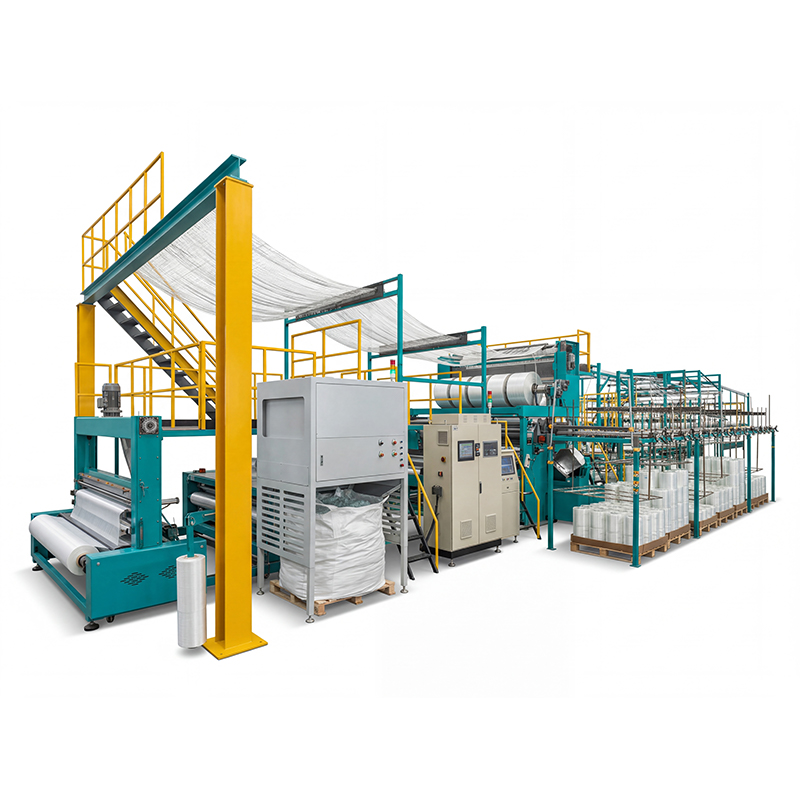
Yuanyang Electromechanical builds warp knitting machinery for chemical fiber, fiberglass, and carbon fiber textiles. You can see the machine range for chemical fiber fabrics on the Warp Knitting Machine for Chemical Fiber Textile page, or send your fabric sample, yarn details, and output target to discuss a suitable configuration.
Frequently Asked Questions
1. What is a Warp Knitting Machine?
A Warp Knitting Machine makes fabric by looping many parallel yarns around needles and linking the loops with sideways movements of guide bars. It produces flat fabric at high speed and over wide widths.
2. What is a Warp Knitting Machine for Chemical Fiber Textile?
It is a warp knitting machine set up for man made yarns such as polyester, nylon, and polypropylene. It needs steady low tension, good let off control, and measures to control static and heat, so it can run fine filaments at speed.
3. What is the difference between tricot and raschel machines?
Tricot machines are faster and suited to fine, smooth fabrics, while raschel machines are more flexible, carry more guide bars, and handle open, patterned, and heavier technical fabrics. Real capabilities depend on the specific model.
4. What gauge should I choose?
Match the gauge to the yarn. Fine filament yarns of about 20 to 70 denier suit E36 to E44, general apparel fabrics suit E28 to E32, and heavier yarns suit E12 to E24. Check the machine data sheet for yarn limits.
5. How do I estimate the output of a Warp Knitting Machine?
Divide the speed in courses per minute by the courses per centimeter to get the fabric length per minute, then multiply by width and by a realistic efficiency of 80 to 90 percent. Multiply by the fabric weight to get kilograms per hour.
6. Which fibers can run on a chemical fiber warp knitting machine?
Polyester, nylon, polypropylene, elastane blends, aramid, and high performance polyethylene can all be knitted, but each needs its own tension, speed, and setup. Describe your yarn to the supplier before choosing a machine.
7. How do I control static when knitting polyester?
Use yarn with antistatic spin finish, keep relative humidity at about 55 to 65 percent, use ionizing bars, and ground the guides and metal parts. Clean the machine regularly.
8. What products suit a weft insertion machine?
Strong, stable base fabrics such as tarpaulin base fabric, geogrid, and reinforcement fabrics, where straight yarns are laid across the fabric and locked by knitted stitches.
9. What causes streaks and lines in warp knitted fabric?
Uneven yarn tension, mixed yarn lots, poor beam preparation, bent needles, and let off or take up variation. Check the beams and yarn batches first, then the machine drives.
10. What should I send a supplier to get a quotation?
Send a fabric sample or drawing, fabric weight, yarn type and denier, target width, monthly output, local power supply, and your plans for automation. If possible, ask for a test run on your own yarn.
News
-
Three quotations land on the same desk for the same polyester nonwoven line, and on paper they look interchangeable. Each is priced per metre of working width. Each quotes a similar top speed. Each c...
READ MORE -
Two quotations land on the same desk. Both offer a multiaxial warp knitting line, both list the same working width, both promise high output. One buyer signs and discovers six months later that the f...
READ MORE -
Which Machine Category Matches Each Technical Fiber and Fabric Goal A warp knitting machine is the primary production platform for technical fiber textiles across fiberglass, chemical fiber, and carbo...
READ MORE -
A fabric engineer compares two swatches on a cutting table. One is a lightweight mesh that holds its shape, resists runs, and stretches very little. The other is a soft jersey that curls at the edges...
READ MORE
-
Contact Info.
+86-198 5534 1617
+86-134 0158 3002yuanyang@yywarpknitting.com 699#, Shengzhi West Rd, Lvcheng Town, Danyang City, Zhenjiang City, Jiangsu Province, China

-
QR Code
-
Quick Links
Home About Products Manufacturing Customization News Contact -
Product List
Machine for Chemical Fiber Textile Machine for Fiberglass Textile Machine for Carbon Fiber Textile -
About Us
Company Profile Factory Gallery Value-added Service
Copyright © 2026 Changzhou Yuanyang Electromechanical Technology Co., Ltd. All Rights Reserved.
Custom Warp Knitting Machine Manufacturers
